Building arm muscle after 55 doesn’t have to be complicated or exhausting. You don’t need heavy dumbbells, long gym sessions, or bulky equipment filling your living space. What works best at this stage is steady tension, joint-friendly angles, and movements that strengthen without leaving you sore for days. Standing exercises fit perfectly here, keeping your body upright, engaged, and naturally aligned. As we get older, muscles respond better to frequent, repeatable loading rather than occasional all-out workouts. Standing arm exercises allow you to train more often because they place less stress on joints while still challenging the muscles. They also activate stabilizing muscles, helping strength transfer to everyday tasks like carrying groceries, opening heavy doors, or lifting items overhead. Resistance bands and bodyweight create constant tension through the full range of motion, which is ideal for muscle growth when joints prefer smooth resistance over abrupt stops. You can easily control tempo, adjust angles, and fine-tune effort without needing heavier weights. The exercises below focus on rebuilding arm muscle while keeping shoulders healthy and posture tall.
If You Can Do This Many Squats in 60 Seconds After 55, Your Leg Strength Is Elite
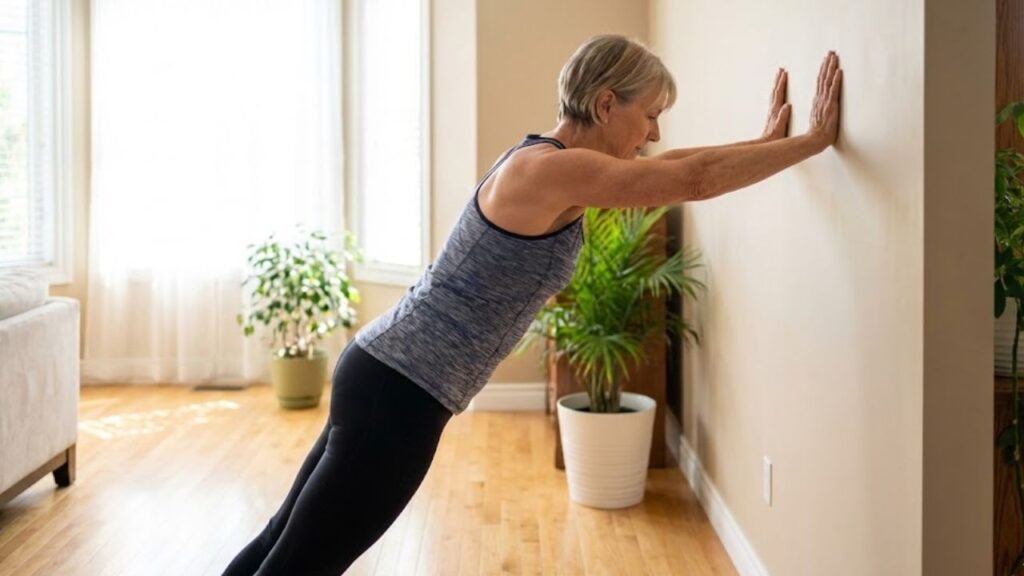
Wall Push-Ups

Wall push-ups place meaningful load on the triceps without forcing the shoulders into uncomfortable positions. Standing tall against a wall keeps your core active and promotes better shoulder alignment than floor push-ups for many adults. Intensity is easy to adjust simply by changing foot distance from the wall, making this movement scalable and joint-friendly.

Muscles Trained: Triceps, chest, shoulders, core. Stand facing a wall with hands at chest height. Step your feet back and keep your body in a straight line. Bend your elbows and lower your chest toward the wall. Press through your palms to straighten your arms and return to the start. Exhale as you push while keeping your core braced.
Recommended Sets and Reps: 3 sets of 10–15 reps, resting 45–60 seconds.
Best Variations: Single-arm wall push-ups, incline push-ups, slow-tempo wall push-ups.
Form Tip: Keep elbows angled slightly back rather than flaring wide.
4 Daily Exercises That Shrink Stubborn Belly Pooch Faster Than Spin Class After 50
Standing Band Curl
Standing band curls maintain tension on the biceps from start to finish, helping stimulate growth without stressing the elbows. Standing posture forces your core and upper back to support the movement, improving arm mechanics and posture at the same time. The resistance increases naturally as you curl, making it smoother on aging joints.
Muscles Trained: Biceps, forearms, upper back. Stand on the middle of a resistance band with feet hip-width apart. Hold the handles with palms facing forward. Brace your core and curl your hands toward your shoulders. Squeeze your biceps at the top, then lower under control.
Recommended Sets and Reps: 3–4 sets of 12–15 reps, resting 45–60 seconds.
Best Variations: Alternating curls, hammer-grip curls, slow-tempo curls.
Form Tip: Keep elbows pinned to your sides throughout the movement.
The 7-Minute Standing Routine That Rebuilds Lost Muscle Faster Than Gym Sessions After 50
Standing Band Tricep Extension
Strong triceps give your arms a fuller appearance and support pressing strength. Band extensions train elbow extension without placing heavy load directly on the joint. Standing tall during the movement challenges shoulder stability and reinforces posture, which often declines with age.
Muscles Trained: Triceps, shoulders, core. Anchor a band overhead or hold it behind your head. Stand tall with elbows bent and pointed forward. Extend your arms until your elbows straighten comfortably. Squeeze your triceps at the top, then return slowly.
Recommended Sets and Reps: 3 sets of 12–15 reps, resting 45–60 seconds.
Best Variations: Single-arm extensions, kickback-style extensions, slow eccentric reps.
Form Tip: Avoid letting elbows flare outward.
This 12-Minute Bodyweight Routine Builds More Strength Than Hour-Long Gym Sessions
Band Pull-Aparts

Pull-aparts strengthen the muscles that support healthy shoulders while indirectly boosting arm strength. A strong upper back allows the biceps and triceps to work more efficiently. This movement also helps correct rounded posture, which can limit arm engagement over time.
Muscles Trained: Rear delts, upper back, biceps, forearms. Hold a resistance band with arms extended at chest height. Set your shoulders down and back. Pull the band apart by driving your hands outward. Pause briefly when the band reaches your chest, then return with control.
Recommended Sets and Reps: 3 sets of 15–20 reps, resting 30–45 seconds.
Best Variations: Overhead pull-aparts, diagonal pull-aparts, slow-tempo reps.
Form Tip: Focus on squeezing your shoulder blades together.
5 Daily Exercises That Restore Leg Muscle Faster Than Weight Training After 55
Standing Band Row
Standing rows train the pulling muscles that give your arms thickness and usable strength. They improve posture while engaging the biceps through a long range of motion. Constant band tension keeps muscles active without stressing the joints.
Muscles Trained: Biceps, upper back, shoulders, core. Anchor a band at chest height. Stand tall with arms extended. Pull your elbows back while squeezing your shoulder blades. Bring the handles toward your ribs, then return slowly.
Recommended Sets and Reps: 3–4 sets of 10–15 reps, resting 45–60 seconds.
Best Variations: Single-arm rows, high rows, slow-tempo rows.
Form Tip: Lead the pull with your elbows, not your hands.
Here’s How Long Your Incline Walking Workout Should Be To Shrink Hanging Belly Fat After 55
The Best Tips for Rebuilding Arm Muscle After 55
Rebuilding arm muscle works best when training feels sustainable and joint-friendly. Standing exercises make consistency easier because they don’t leave you feeling worn down. Strength improves through steady effort over time rather than pushing every set to exhaustion.
Train arms two to three times per week for consistent stimulation.
Control each rep to increase time under tension.
Maintain tall posture to improve strength transfer.
Support recovery with adequate protein and hydration.
Increase resistance gradually while keeping movements pain-free.