Just after lunch, the light starts to feel… wrong. Shadows stretch a little too far, colors fade a shade too fast, and conversations slow as people glance up from their phones toward the sky. On roofs, in schoolyards, at gas stations along quiet highways, strangers gather with cardboard glasses and homemade pinhole boxes, laughing nervously like they’re waiting for a train that might not come. Streetlights flicker on even though it’s still afternoon. Birds get confused and fly low. Somewhere a dog starts to howl.
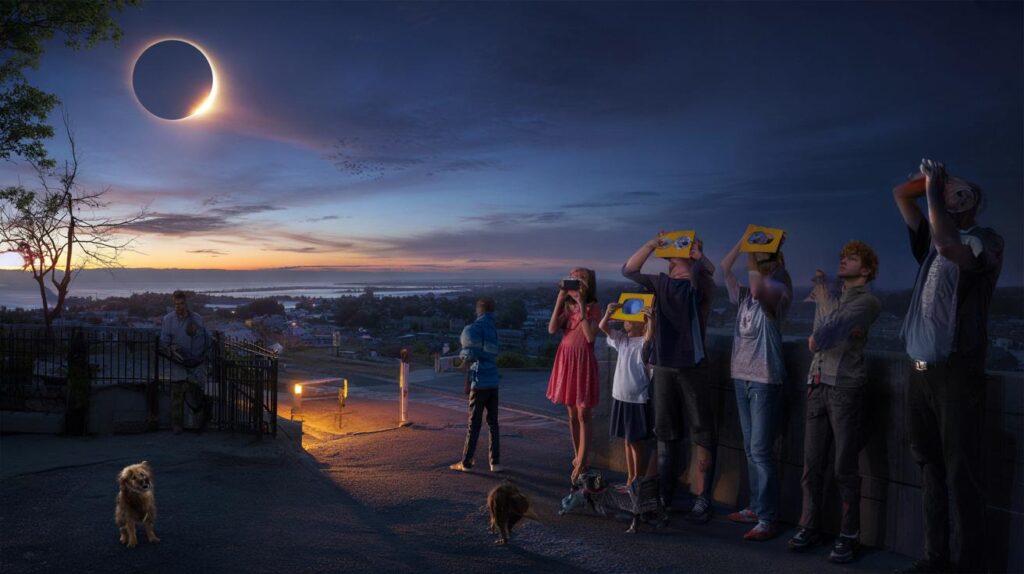
Then, almost without anyone noticing the exact second, the last sliver of sun disappears.
Day turns to a slow, unreal night.
The day the Sun forgets the time
The longest total solar eclipse of the century will not feel like a sudden flick of a cosmic switch. It will feel like a hesitation. A long, shivering pause in the middle of the day, stretching across several regions and millions of lives.
The light will drain away over many minutes, like dimmers being turned down in a stadium, row by row. People will whisper even if they’re outdoors, because bright daylight has taught us that we’re supposed to be loud. This time, we’ll fail that old habit.
For once, everyone will be staring at the same thing.
Think of a narrow, sinuous shadow racing across the Earth at more than 1,500 km/h. On its path: small towns with one main street, coastal megacities, quiet rural villages, and packed tourist hubs that have been booked solid for months. In one city, schoolchildren will spill into playgrounds with cereal-box viewers. In another, office workers will sneak to rooftops and parking decks, laptops left open on their desks like paused lives.
Traffic will slow to a puzzled crawl, not because cars can’t move, but because drivers will pull over “just for a second.” That second will stretch.
Somewhere along that track, totality will last more than seven astonishing minutes.
Long eclipses are rare because the universe has to line up with ridiculous precision. The Moon needs to be just the right distance from Earth. The Earth the right distance from the Sun. The orbital geometry has to deliver a path that lingers, as if the shadow itself doesn’t want to leave.
Astronomers can predict this dance down to the second, with maps colored like weather forecasts but for darkness. For them, this eclipse is a once-in-a-lifetime lab experiment in the wild, a chance to study the solar corona and the way our atmosphere reacts when daylight gets yanked away. For the rest of us, it’s less about science and more about sensation.
We’ll feel the temperature fall on our skin before we see the final bite of light disappear.
How to live those long minutes without missing a thing
There’s a rhythm to a long total eclipse, and the trick is not to rush it. The first thing is practical: you need proper eclipse glasses with certified solar filters, not just “dark” sunglasses from a gas station. That thin orange or white film is the difference between wonder and a visit to the eye doctor.
Before the big day, step outside at the exact time the eclipse will start where you live. Notice where the Sun sits, which way the shadows fall, where you could stand with a clear view. Treat it like a rehearsal for one of the strangest shows on Earth.
On eclipse day, arrive early, breathe, and let the sky take over.
We’ve all been there, that moment when you finally reach the special event and end up watching it through your phone screen. The longest eclipse of the century is exactly when you don’t want to fall into that trap. By all means, take a few photos, but resist turning it into a three-hour filming session.
A better plan is simple: during the partial phases, snap your pictures, compare crescent-shaped suns with your friends, giggle about the weird half-shadows on the ground. Then, in the last minute before totality, put every camera down. Physically lay it on the ground if you have to. *Let those minutes belong entirely to your eyes, your skin, your heartbeat.*
Let’s be honest: nobody really does this every single day.
There’s also the emotional side, the part you can’t really prepare for on a checklist. People cry at eclipses. Grown adults, scientists with decades of data behind them, teenagers who thought they were too cool to care. When the Sun’s last bead of light disappears and the corona blooms like a ghostly crown, something in your brain quietly rewrites what “day” means.
“During totality, I felt like the universe had hit pause,” recalls Lina, a 34-year-old teacher who travelled across three countries to catch a previous long eclipse. “I looked around and everybody’s face had this same expression: not fear, not joy exactly. Just… stunned.”
- Arrive at your viewing spot at least one hour before the first contact.
- Use proper eclipse glasses for every partial phase, especially for kids.
- Plan a “no screens” moment for the full duration of totality.
- Bring a light jacket: temperatures can drop quickly in the shadow.
- Talk about what you’re feeling, not just what you’re seeing.
When the shadow moves on and the world starts again
After the longest darkness, the light returns almost rudely fast. Birds will restart their songs in messy bursts, as if someone pressed play on a playlist mid-track. People will look at each other and laugh, slightly embarrassed, cheeks damp, eyes darting between their phones and the sky, trying to decide what to do next.
Some will rush to post that perfect shot of the corona. Others will stand frozen for a few more seconds, trying to hold onto the feeling that time had edges. A few will already be checking maps of future eclipses, whispering “Where’s the next one?” under their breath.
The strange part is how quickly normal life pretends nothing happened. Coffee shops will reopen their laptops and their playlists. Kids will be herded back into classrooms. Trains will run on schedule, bosses will ask about deadlines, and the biggest cosmic show of the century will turn into a line on your calendar history.
Yet for many, the memory will sit there like a small, bright bruise. A quiet reminder that the Sun can vanish in the middle of a Tuesday, that familiar things can change color and meaning in a matter of minutes, and that we are all — whether we admit it or not — living under the same fragile, shared sky.
Long after the shadow has crossed its last stretch of sea and slipped off the edge of the planet, the stories will keep spreading. A grandmother telling her grandchildren how the streetlights came on at two in the afternoon. A mechanic saying the air felt “thick, like before a storm but stranger.” A teenager remembering that for once, the whole town stood still.
These are the details that outlive the numbers and maps. They’re what you might share with a friend years from now, when the news teases the next great eclipse and you both instinctively glance up.
The Sun will keep rising and setting unnoticed most days. Yet on that long, stretched-out crossing of darkness, it will have reminded us that daylight is a gift, not a default setting.
| Key point | Detail | Value for the reader |
|---|---|---|
| Longest totality of the century | Some locations will experience more than seven minutes of complete darkness | Helps readers grasp why this eclipse is a truly once-in-a-lifetime event |
| Preparation matters | Safe viewing gear, scouting the viewing spot, and planning “no-screen” time | Gives readers a simple way to experience the eclipse fully and safely |
| Emotional impact | Shared silence, unexpected tears, and a new sense of the sky | Invites readers to see the eclipse as a human moment, not just a science headline |
FAQ:
- Question 1Can I look at the eclipse with regular sunglasses?Answer 1No. Regular sunglasses, even very dark ones, do not block the intense solar radiation. You need certified eclipse glasses or a proper solar filter designed specifically for direct Sun viewing.
- Question 2Is any part of the eclipse safe to watch with the naked eye?Answer 2Yes, but only during totality, when the Sun is completely covered and you can see the corona. Before and after totality — during every partial phase — you must protect your eyes.
- Question 3What if clouds cover the sky?Answer 3Even behind thin clouds, the dimming and temperature drop can be intense and moving. You may not see the corona sharply, but you’ll still feel that eerie midday twilight sweep across your surroundings.
- Question 4How can I photograph the eclipse without damaging my camera?Answer 4Use a proper solar filter over your lens during the partial phases, just like for your eyes. During totality, you can briefly remove the filter, but keep exposures short and avoid staring through unfiltered optical viewfinders.
- Question 5Will animals really behave differently during the eclipse?Answer 5Yes, many do. Birds may roost, insects may change their buzzing patterns, and pets can become restless or oddly quiet as the light and temperature shift in a way their instincts don’t quite understand.