Across Europe and North America, hospitals see a sharp rise in broken wrists, hips and ankles as soon as pavements freeze. The good news: a few simple habits and low-tech tricks can dramatically cut the risk of slipping on black ice, snow and frozen slush.
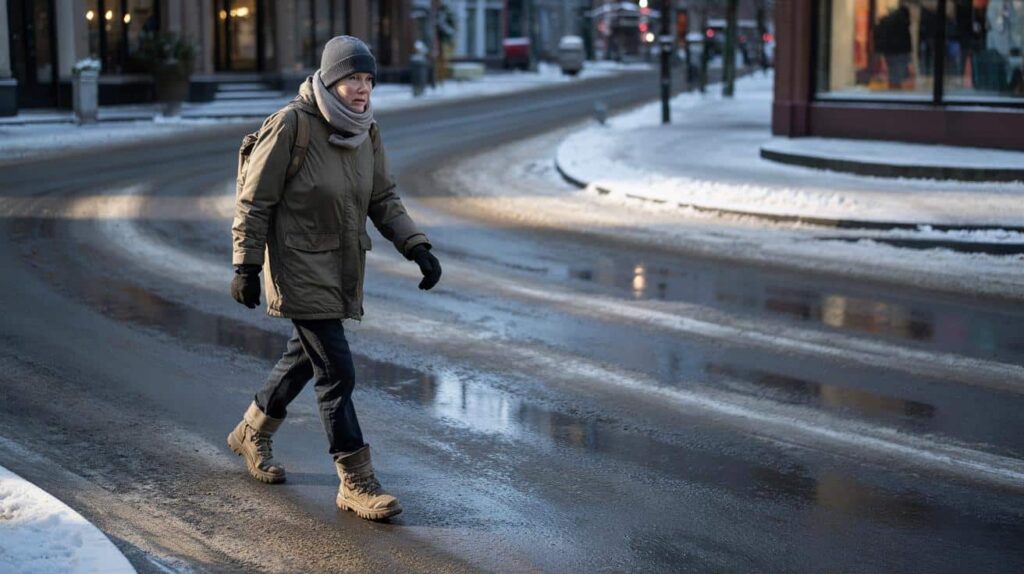
Why black ice is so dangerous
Black ice is thin, transparent ice that blends into tarmac or pavement. It often forms overnight or after light drizzle that freezes on contact with the ground.
Most people fall on winter streets not during a blizzard, but on apparently “normal” mornings when the ground looks harmless.
1. Wear footwear that actually grips
The best winter safety tool is on your feet. Fashion trainers with smooth soles have almost no traction on ice. Instead, choose boots or shoes with deep, rubber treads that bite into snow and slush.
- Pick ankle-high or higher boots to support the joint if you twist.
- Avoid worn, flat soles that have lost their pattern.
- Look for winter or “trail” designs rather than city loafers.
In very icy conditions, some walkers slide thick sports socks over their boots to add friction. It is not elegant and the socks will not survive the day, but the extra grip can make a real difference on untreated pavements.
2. Favour fresh snow over polished paths
Freshly fallen snow often gives more traction than compacted, shiny surfaces. When you have a choice, walk on the clean, slightly crunchy layer rather than on flattened, grey tracks where others have already walked and slid.
Once snow has been compressed, the pressure and slight warmth from feet or tyres can turn it into a thin sheet of ice. That is when it behaves like a hidden skating rink.
Think of clean, squeaky snow as your friend, and glossy, glassy patches as a silent warning sign.
3. Try the “penguin walk” on ice
On very slippery stretches, walking normally is asking for trouble. Shorten your stride, lean slightly forward and keep your feet under your body, not out in front.
How to copy the penguin walk
- Take small, flat-footed steps rather than long strides.
- Keep your centre of gravity over your front leg.
- Turn your feet slightly outwards for better stability.
- Let your arms hang loosely by your sides for balance.
You may feel a bit silly, but this slow shuffle keeps your weight where you can control it. Ski resort staff, postal workers and delivery drivers use this technique every winter for a reason.
4. Use a backpack, not a shoulder bag
The way you carry your belongings can tip you off balance. A heavy handbag, laptop satchel or one-strap messenger bag pulls your body to one side and slows your reaction if you start to slide.
Weight evenly distributed in a backpack frees your arms and helps your body react faster when a foot slips.
Keep loads as light as possible on icy days. If you must carry shopping, split it between two bags and hold one in each hand. This keeps your upper body more symmetrical and less likely to twist awkwardly if you fall.
5. Slow your walking speed right down
Most winter falls happen because people move at their usual pace on surfaces that are anything but usual. Treat each step as a decision, not an automatic movement.
Practical pacing tips
- Allow extra time for your journey so you are not tempted to rush.
- Test new surfaces gently with your toe before putting full weight down.
- Avoid sudden turns; pivot slowly rather than spinning on one foot.
- Keep your gaze ahead, not down at your shoes, to help your body stay aligned.
Looking straight ahead might feel counterintuitive when you are nervous, yet it helps your inner ear and body work together to maintain balance.
6. Keep your hands out of your pockets
On freezing mornings, people instinctively bury their hands deep in their coat pockets. That reaction removes one of your best tools for staying upright.
Free arms act like tightrope balancers’ poles: they steady you, and they help you catch yourself if you fall.
Wear good gloves or mittens so your hands can tolerate the cold while staying ready. If you do slip, try to keep your arms slightly bent to absorb impact rather than locking your elbows and risking fractures.
7. Choose the safest side of the street
Not all pavements in the same street are equal. One side often gets more sun and thaws earlier. The other may sit in permanent shade, preserving a slick of ice all day.
| Surface | Risk level | Comment |
|---|---|---|
| Sunny pavement | Lower | Thaws faster, often wet rather than icy by mid-morning. |
| Shady pavement | Higher | Ice lingers, especially near walls and hedges. |
| Steps and ramps | Very high | Often hide thin ice; handrails are crucial. |
Whenever possible, walk on the side that has seen more daylight. Be particularly careful with stairs, sloped driveways and underground entrances, which tend to freeze early and thaw late. Always use handrails, even for short flights.
8. Consider walking poles or a simple stick
For people who walk long distances, have balance issues or live in hilly areas, extra points of contact with the ground can be transformative. Lightweight hiking poles or Nordic walking sticks offer two additional supports.
Poles need to be adjusted to the right height: typically, your elbow should be at roughly a 90-degree angle when the tip touches the ground. On ice, plant the pole firmly before you shift your weight forward.
Two extra “legs” give you a wider base and can prevent a slip becoming a full fall.
Those who do not want to invest in poles can sometimes use a sturdy, non-metal walking stick with a rubber tip. Some specialist winter tips come with small spikes designed for icy paths.
9. Learn how to fall with less damage
No strategy removes risk completely. When you do fall, the way your body lands can determine whether you end up with bruises or broken bones.
Safer falling tactics
- If you pitch forwards, try to bend your elbows and let your forearms take some of the impact, then roll slightly to spread the force.
- If you are tipping backwards, resist the instinct to put both hands straight out behind you. Let your backside take most of the impact and tuck your chin to protect your head.
- Where possible, keep your body relaxed rather than rigid; tension increases the chance of fractures.
These ideas come from martial arts and physiotherapy practices, where people learn to distribute impact over larger areas of the body instead of concentrating it in fragile joints.
Who is most at risk – and what extra steps help?
Older adults, pregnant women and anyone with reduced mobility face higher danger from winter falls. A simple wrist fracture for a teenager may mean a life-changing hip fracture for a grandparent.
For these groups, small adjustments matter a lot:
- Schedule outings for daylight hours, when ice is more visible.
- Ask family or neighbours to clear paths and scatter grit or sand.
- Consider slip-on ice cleats for regular trips, such as dog walks or commutes.
- Use public transport stops you can reach without steep slopes or tricky shortcuts.
Understanding the different kinds of winter surfaces
Not all slippery ground is the same, and recognising the differences helps you react correctly. Black ice is nearly invisible and glassy; your best defence is extreme caution and a penguin-style walk. Packed snow often has a grainy look and may squeak underfoot, offering some traction but turning treacherous as soon as temperatures rise and refreeze.
Wet slush can hide frozen ridges. Your boots may sink, then suddenly slide sideways. On such ground, shorten your steps and keep your knees slightly bent, so you can adapt quickly if your foot moves unexpectedly.
Reading the ground in winter is a skill: once you learn it, every pavement tells you a story about how to walk on it.
Combining good footwear, smarter walking habits and a bit of awareness turns an icy commute from a daily gamble into a manageable risk. Your future self, and your unbroken bones, will be glad you took a few extra seconds with each step.