The woman in the mirror squints, leans in, and sighs. Not because of the new fine line around her eyes, but because of those three stubborn silver hairs glinting at her parting like tiny neon signs. She knows the routine by heart: box dye, towel over shoulders, chemical smell filling the bathroom for 35 minutes, scroll through her phone, rinse, stain the sink. Two weeks later, the same scene. New greys. New sigh.
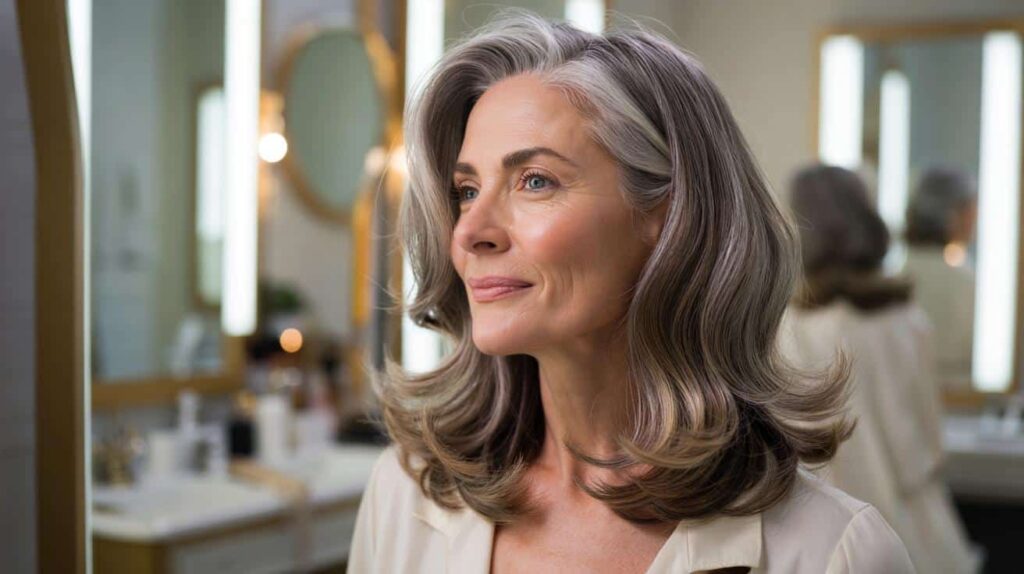
Yet lately, something strange is happening in bathrooms and salons. The dye boxes are staying closed. Grey is still there, but softer, blended, even… flattering.
There’s a new way of dealing with grey hair that doesn’t mean going “full granny” overnight or going back to roots every 10 days.
And it’s quietly changing faces in the street.
From hiding grey to softening it: a discreet revolution
Walk into any salon right now and listen carefully. You’ll hear fewer “I want to be dark brown again” and more “Can we just blur the grey a bit?” It sounds subtle, but that shift is huge.
Instead of fighting every single white strand, women are asking for a softer transition. Less block color, more dimension. Less “I can’t have grey” and more “I don’t want to look tired”.
This is the emerging trend: coverage without the heavy, flat, obviously dyed look.
Grey hair is still there, just… edited.
Take Sophie, 47, who used to color her hair religiously every three weeks. She’d panic when her roots hit that infamous 1-centimetre mark, booking emergency appointments and planning weekends around her dye sessions. The day she skipped one, her teenage daughter told her, “You look kind of cool with that silver stripe.”
She laughed it off, but it stuck in her mind. A few weeks later, instead of her usual all-over dye, her hairdresser suggested something else: ultra-fine highlights and lowlights to blend the grey rather than erase it.
Three hours later, Sophie walked out with hair that wasn’t “brown” or “grey”, but a mix of both. Her friends didn’t say, “Nice color.”
They said, “You look really rested.”
What’s happening on heads like Sophie’s has a simple logic. Harsh, uniform dye often creates a helmet effect that screams “I color my hair.” It flattens the face and hardens features, especially once skin tone shifts with age.
Soft grey-blending does the opposite. It introduces light and movement, tricks the eye, and spreads the grey so the regrowth line almost disappears. Instead of that sharp border at the roots, you get a gradient.
The visual message isn’t “I’m hiding something.”
It’s “This is just my hair, but in a better light.”
The new technique that’s stealing the show: grey blending
The star of this trend has a name: grey blending. Think of it as a peace agreement between your natural color and your silvers. Not full-on dye, not full-on grey, but a mix crafted to look effortless.
Here’s how it usually works in a salon. The colorist uses ultra-fine highlights, sometimes babylights, around the face and in the top layers. Then they add slightly deeper lowlights where your natural color is still strong, so the grey doesn’t sit alone.
Roots become softer. Lines disappear. You don’t walk out feeling “colored”.
You walk out feeling like your hair finally matches your age… in the best possible way.
The biggest mistake many people made for years was chasing their “original” hair color at all costs. Dark brown at 22 doesn’t look the same next to 48-year-old skin. That’s where the classic dye trap hits: hair too dark, face suddenly older, features harder.
With grey blending, the mindset changes. Instead of saying “I want to be brunette again,” you say, “I want a color that suits my face now.” Your hairstylist works with the grey, not against it. The result is often a soft mix of beige, ash, or smoky tones that wrap around the silver, almost like a filter.
Let’s be honest: nobody really does this every single day – the fancy masks, the weekly gloss, the perfect blow-dry.
Grey-blended hair is designed to still look good on the days you just wash, scrunch, and go.
There’s also a psychological side to this. Going “cold turkey” from dyed brown to full white terrifies a lot of people. Grey blending gives them a bridge. You keep some depth, some contrast, some of your “old you”, but you soften everything around it.
One Parisian colorist I spoke to put it bluntly:
“Full coverage dye is like a filter from 2012. **Grey blending is the 2026 version – lighter, softer, more honest, and kinder to the face.** People don’t want perfection. They want believable.”
Alongside grey blending, a few complementary moves are gaining ground:
- **Face-framing highlights** that brighten the features without touching the whole head
- Gentle glosses to neutralize yellow or dull tones in older hair
- Soft toners that keep silver hair shiny instead of matte and lifeless
- Strategic lowlights to avoid the “block of white” effect at the front
*The goal isn’t to look 25 again, but to look like yourself on a really good day.*
A new relationship with age… and the mirror
What this trend quietly questions is our relationship with age itself. Not the big speeches about “embracing wrinkles”, but the small, intimate moment in front of the bathroom mirror. The second you decide: fight or negotiate?
Grey blending, and all these new softer techniques, are basically a third way. Not giving up, not hiding everything, but tidying reality. Like touching up a photo without airbrushing it beyond recognition.
Some women say they feel strangely relieved. They no longer live by the calendar of their roots. The guilt of “I should have done my color last week” fades.
The line between “me with dye” and “me without” blurs into something more relaxed.
| Key point | Detail | Value for the reader |
|---|---|---|
| Grey blending over full coverage | Ultra-fine highlights and lowlights mix with natural grey | Softer regrowth, fewer salon visits, less pressure to hide every strand |
| Lighter, multi-tonal shades | Colors slightly softer than your original, with dimension | Face looks fresher and younger, without obvious “dyed” effect |
| Transition strategy | Use blending, gloss and toners to move from dye to natural | A calmer, more gradual way to accept grey without feeling “old” overnight |
FAQ:
- Question 1What exactly is grey blending compared to traditional dye?
- Question 2How often do I need to go to the salon with this new technique?
- Question 3Can grey blending work on very dark hair or almost fully grey hair?
- Question 4Will I damage my hair less if I switch from full dye to grey blending?
- Question 5What should I ask my hairdresser if they haven’t heard of “grey blending”?