The first thing you notice is the flash of orange-red, low against the frosty hedge.
It’s barely light, your breath is hanging in the air, and that plump robin is already perched on the same branch as yesterday, head cocked, eyes locked on your patio table.
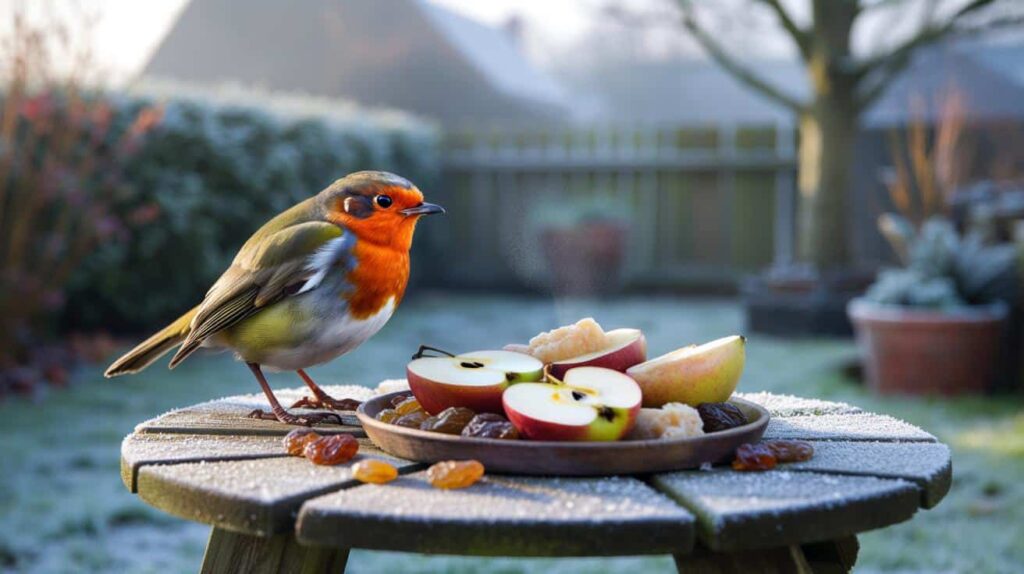
You step outside with a bowl of chopped apples and raisins.
Within seconds, there’s a flutter, a soft tick-tick call, and then the bird is there, bold as a regular customer at the corner café.
You swear he looks annoyed if you’re late.
Bird experts say this isn’t just cute.
It’s a full-blown winter addiction.
Why robins are suddenly treating your garden like a snack bar
Watch a garden through one cold week and you start to see a pattern that feels almost scripted.
The robin that once stayed hidden in the hedgerow is suddenly front and center, following you around as you brush leaves or open the shed door.
He’s not shy anymore.
He’s waiting.
Not for worms, but for that pile of winter fruit you’ve “just put out for the birds”.
What feels like generosity from you is, in his world, a high-calorie jackpot in the hardest season of the year.
One British bird group logged backyard observations last winter and spotted the same thing across hundreds of gardens.
Robins were visiting feeding spots up to ten times more often on days when people put out soft fruit.
Think halved apples pressed onto branches, mashed banana on a saucer, a handful of raisins soaked in warm water.
Gardeners thought they were just using up leftovers from the fruit bowl.
The birds clearly got the memo.
“Once I started putting out chopped pear at 7 a.m., my robin began waiting on the fence at 6:50,” laughed one observer.
That’s not random.
That’s routine.
From a robin’s point of view, winter is a brutal maths problem.
Short days, frozen soil, insects gone quiet, energy needs sky-high just to stay alive through sub-zero nights.
Fruit solves several problems in one go.
It’s soft enough for their fine bill, packed with sugars for fast energy, and when placed in the same spot daily, it becomes predictable.
Predictable is gold in winter.
This is why experts talk about a “fruit trick”.
Not because we’re tricking the birds, but because repeated, easy calories teach them that your garden is the place to be, day after day.
The winter fruit trick that turns robins into regulars
Bird specialists are surprisingly specific about the kind of fruit that turns a casual robin visit into a loyal habit.
They talk about “soft, open, and low”.
Soft, as in ripe apple, pear, or berries that a small beak can easily tear.
Open, as in cut fruit where the juicy part is exposed, not rock-hard supermarket windfalls.
Low, as in at ground or low table level, where robins naturally forage.
Set that up in the same quiet corner each morning and you’ve just designed the perfect robin routine.
You don’t need much.
A few spoonfuls, placed regularly, beats a huge pile once in a while.
This is where many of us get tangled between good intentions and real-life habits.
We fling out a mountain of grapes on Sunday, feel virtuous, then forget about the birds until the next cold snap two weeks later.
Let’s be honest: nobody really does this every single day.
That stop‑start rhythm confuses birds that have already re-wired their winter routes around your garden.
They burn energy to visit, then find nothing.
Experts suggest a more human approach.
Pick a realistic rhythm that fits your life — maybe three mornings a week before work — and keep to that, instead of chasing some perfect daily routine you’ll abandon by mid-January.
“Robins are fast learners,” explains urban bird ecologist Dr. Mae Foster.
“Give them reliable, safe food at a regular time, and they’ll build your garden into their winter survival map.
Stop suddenly, and they still come for a while, burning through precious energy on an empty visit.”
- Best fruits for robins
Ripe apples and pears (halved), currants, raisins soaked in warm water, small pieces of soft banana. - Where to place them
On a low table, tree stump, or large flat stone, away from cats and busy paths, in the same spot every time. - What to avoid
Citrus, salted or sugared leftovers, moldy fruit, and anything with added flavourings or alcohol. - How much to offer
A small handful per session. Enough to help, not so much that it sits and spoils. - When to stop
As spring advances and insects reappear, gradually reduce fruit so birds switch back to natural food.
Living with your new feathered “addict”
Once a robin decides your garden is worth the trip, the relationship shifts in ways that feel oddly personal.
You open the back door and there he is, almost theatrically early, tilting his head, watching your every move.
There’s a tiny rush each time he swoops down as soon as you step back.
You find yourself talking to him, giving him a name, noticing the way his chest feathers puff in the wind.
We’ve all been there, that moment when a wild bird starts to feel like a tiny neighbor with a standing appointment.
Yet behind the charm, there’s a quiet responsibility growing too.
The emotional trap is real.
You miss one feeding and feel guilty, as if you’ve cancelled on a friend in bad weather.
You see him hunting around the empty spot and instantly start cutting more fruit than you intended.
*That’s the hidden side of the winter fruit trick: it hooks us as much as the birds.*
Experts gently remind us that wild birds still have other options, even if we scale back.
The goal is support, not dependence.
A good rule of thumb is to be lovingly consistent in the coldest weeks, then consciously loosen the routine when daylight stretches and the soil softens.
Robins also bring visitors.
Once there’s always fruit on offer, blackbirds may muscle in, dunnocks sneak underneath, even a wood pigeon might lumber over.
Your robin can’t read the sign that says “reserved”.
That’s where small adjustments help everyone.
Offer fruit in two or three small patches, not one big plate, so the robin can grab a share without constant fights.
Keep the area reasonably clean, raking away mushy leftovers that attract rats.
Some birders also mix in a little high‑quality insect-based food with the fruit to keep diets balanced, especially in long cold spells.
You’re not running a perfect lab.
You’re just nudging the odds in favor of survival.
At some point in late winter, there’s a morning when you step outside with your usual bowl and notice the silence.
No bright eye in the hedge, no ticking call from the fence.
The fruit sits untouched for hours.
For a second you imagine the worst, then remember what the experts kept repeating: this was always meant to be a temporary winter pact.
Robins shift back to their natural rhythm as soon as they can.
That empty spot on the table is oddly moving.
It holds all those frozen mornings, the quiet companionship, the sense that your small corner of the world could be a refuge when life was hardest for a creature you barely knew.
You might find yourself cutting an apple out of habit next December, just to see if a new red chest appears in the frost.
| Key point | Detail | Value for the reader |
|---|---|---|
| Soft winter fruit builds routine | Ripe apples, pears, and soaked dried fruit offered regularly teach robins to visit the same spot | Helps you reliably attract robins and enjoy close, repeat encounters |
| Consistency beats quantity | Small portions on a predictable schedule are better than big, irregular dumps of food | Reduces waste, supports bird health, and fits more realistically into everyday life |
| Support, don’t replace, wild foraging | Gradually reduce fruit as weather softens so robins return to natural food sources | Protects long‑term behavior and keeps your help aligned with the seasons |
FAQ:
- Do robins really remember individual gardens?
Yes. Robins quickly learn which gardens offer easy food and will build these stops into their daily winter routes, often visiting at roughly the same times each day.- What’s the single best fruit to start with?
A simple halved apple, placed cut‑side up on a low table or stump, is an excellent starting point and is widely accepted by robins and other garden birds.- Can I give robins kitchen scraps instead of fruit?
Small amounts of plain, unsalted scraps are sometimes eaten, but experts prefer soft fruit and insect‑based foods. Avoid salty, seasoned, moldy, or sugary leftovers.- Will feeding fruit make robins dependent on me?
Short‑term support in the coldest months is helpful, not harmful, especially if you gradually reduce feeding as natural food returns in spring.- Is it safe to feed robins every winter in the same spot?
Yes, as long as you keep the area reasonably clean, offer suitable foods, and allow birds to shift back to wild foraging when conditions improve.