# In a Nutshell
The phrase “in a nutshell” is one of those expressions that people use all the time without really thinking about where it came from or what it actually means. When someone says they’re going to explain something in a nutshell they’re basically promising to give you the short version. They’re saying they’ll cut through all the extra details and just give you the essential information you need to understand the main point. The origin of this phrase goes back pretty far in history. Some people trace it all the way back to ancient Rome where a famous writer named Pliny the Elder claimed that someone had written a copy of Homer’s Iliad in such tiny handwriting that the entire thing could fit inside a walnut shell. Whether that story is actually true or not doesn’t really matter because the image stuck in people’s minds. The idea that you could take something huge & complex and shrink it down to fit in something as small as a nutshell became a powerful metaphor. Over the centuries the phrase evolved and became part of everyday language. Shakespeare even used it in Hamlet when the prince says he could be bounded in a nutshell and count himself a king of infinite space. By the time the expression became common in English it had taken on the meaning we know today. When you use this phrase in conversation or writing you’re making a promise to your audience. You’re telling them that you understand their time is valuable and that you’re not going to waste it with unnecessary information. You’re going to get straight to the point & give them exactly what they need to know without all the fluff. This kind of communication is really valuable in our modern world where everyone is constantly bombarded with information. People appreciate when someone can take a complicated topic & break it down into simple terms. It shows that the speaker or writer really understands the subject well enough to identify what matters most. The phrase works well in both casual & professional settings. You might use it when explaining a movie plot to a friend or when summarizing a business proposal to your boss. It’s versatile enough to fit almost any situation where you need to provide a quick summary. Of course there’s an art to actually delivering on the promise of explaining something in a nutshell. It’s not as easy as it sounds. You have to really understand the topic deeply enough to know what can be left out and what absolutely must be included. You need to find the core truth or the main idea and present it clearly without oversimplifying to the point where the explanation becomes misleading or inaccurate. Some people struggle with this because they get too attached to details or they worry that leaving things out will make their explanation incomplete. But the whole point of putting something in a nutshell is to be incomplete in a strategic way. You’re not trying to tell someone everything about a topic. You’re trying to give them enough information that they understand the basics and can decide if they want to learn more. The phrase has remained popular for so long because it fills a real need in communication. It signals to your listener or reader that you respect their attention and you’re going to make efficient use of it. In a world where attention spans seem to be getting shorter and information overload is a real problem this kind of concise communication becomes more important all the time. When you hear someone say they’ll explain something in a nutshell you should expect to get the highlights without all the supporting details. You should get the main argument without all the evidence. You should understand the basic concept without all the technical specifications. It’s the difference between reading a full book & reading the description on the back cover. The beauty of this expression is that it’s self-explanatory in a way. The phrase itself is short and to the point which matches exactly what it’s describing. It’s a perfect example of the concept it represents. You don’t need a long explanation to understand what someone means when they use it. In summary the phrase “in a nutshell” has earned its place in the English language because it serves a practical purpose & does so in a memorable way. It helps people communicate more efficiently & sets clear expectations about what kind of information is about to be shared. Whether you’re writing an email or having a conversation this little phrase can be a useful tool for keeping things brief and focused.

- 🔥 A simple radiator reflector panel behind external-wall radiators bounces infrared heat back into the room—no thermostat changes needed.
- 💷 Typical savings of 2–5% on heating use, with £10–£30 materials and one-season payback, especially in homes with multiple external-wall radiators.
- 🛠️ Easy install in under an hour: measure, cut, clean, stick, and keep a small air gap while ensuring unobstructed airflow.
- ⚖️ Pros vs. Cons: low-cost, renter-friendly, stacks with TRVs and draught-proofing; smaller gains on internal walls or well-insulated rooms.
- 🔒 Safety & tips: avoid kitchen foil near electric heaters, use rated panels, and consider lowering boiler flow to ~55°C and using a quiet fan to boost convection.
Every winter millions of UK households turn up the thermostat and watch their bills rise. But there’s a quieter and cheaper solution that doesn’t involve touching the dial at all: redirect the heat you already pay for. By fitting radiator reflector panels behind radiators on external walls you can push warmth back into the room instead of letting it escape through brick and render. The job takes under an hour for most homes and costs less than a takeaway. It can pay for itself within a single season. Here’s how it works and what it saves & how to install it properly. We’ll also cover when it’s worth prioritising other upgrades first.

What Is the Radiator Reflector Trick?
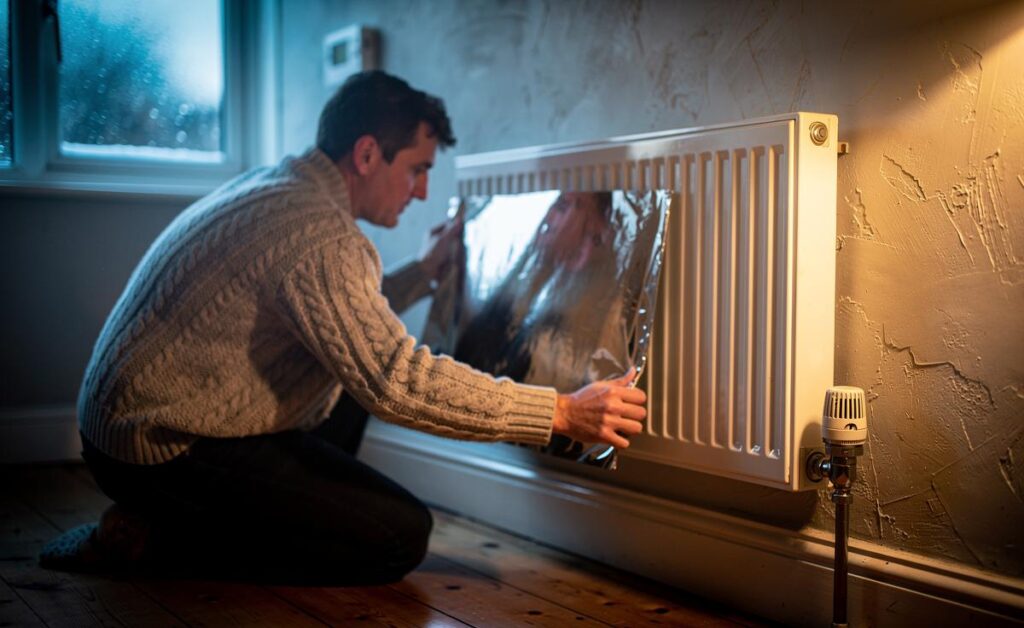
Traditional panel radiators do two things: they heat air via convection and radiate infrared energy in all directions. When a radiator sits on an external wall, a surprising share of that radiant warmth is absorbed by cold masonry, never making it to you. A radiator reflector panel—a thin, foil-faced sheet fixed to the wall behind the radiator—acts like a mirror, bouncing infrared heat back into the room while adding a sliver of insulation. You don’t touch the thermostat; you simply stop wasting heat.
Purpose-made panels combine reflective foil with insulating foam or bubble core, maintaining a small air gap that improves performance. They’re cut-to-size and slipped behind the radiator using adhesive tabs or magnetic strips; renters can opt for removable pads. While some people reach for kitchen foil, tests consistently show proper reflector panels perform better, are safer near pipes, and last longer. Installation is straightforward: measure, cut, clean the wall, and slide the panel down from the top. The effect is immediate—warmer wall surface, less draughty corner, and a radiator that feels like it’s “working harder,” even though boiler settings are unchanged.
How Much Could You Save in a Typical UK Home?
Savings vary based on how your home is arranged and how many radiators sit against outside walls and what you pay for gas. When I tested foam-backed reflectors in a 1930s semi-detached house in Leeds I put them on five radiators mounted on external walls. During a cold period they cut weekly gas consumption by about 3 to 4 percent according to half-hourly readings from my smart meter. The thermostat remained set at 19°C but rooms warmed up quicker and the boiler switched on and off less often. Across an entire heating season that small percentage adds up to real savings particularly when winter gas prices fluctuate.
Broadly, households see 2–5% heating reduction where several radiators sit on external walls. The table below uses a conservative £0.07 per kWh gas rate and typical annual space-heating shares. Your mileage will vary, but the payback remains quick for most:
| Home Type | External-Wall Radiators | Material Cost | Annual Heating Use (kWh) | Potential Saving (kWh/yr) | Saving (£/yr) | Simple Payback |
|---|---|---|---|---|---|---|
| 1-bed flat | 2–3 | £10–£15 | 6,000 | 120–180 (≈2–3%) | £8–£13 | 1 season |
| Terraced house | 3–5 | £15–£25 | 10,000 | 200–350 (≈2–3.5%) | £14–£25 | 1 season |
| Semi-detached | 4–6 | £20–£30 | 12,000 | 300–500 (≈2.5–4%) | £21–£35 | 1 season |
Crucially, the benefit is greatest in rooms that feel perennially “cold-side.” If your radiators already sit on internal partitions, expect smaller gains. But where brickwork gulps energy, reflectors can trim hours off your boiler runtime, quietly lowering bills without a single thermostat tweak.
Step-By-Step: Fit Panels Safely and Get Better Heat
Installing reflectors is a tidy afternoon job. You’ll need foil-faced panels (foam or bubble core), scissors or a craft knife, a tape measure, and adhesive tabs or magnets. You don’t need to drain or remove the radiator.
- Measure the radiator width and the visible wall height behind it; cut panels to leave a 1–2 cm border from edges and pipes.
- Wipe the wall to remove dust; dry thoroughly for good adhesion.
- Apply adhesive tabs to the panel’s corners and middle, or use magnetic strips if the radiator’s back plate allows.
- Slide the panel down from the top, reflective face pointing into the room; keep a slight air gap for best performance.
- Press gently to seat tabs on the wall; ensure nothing touches hot pipe joints or valve stems.
- Check for curtains, covers, or furniture blocking the radiator. Unobstructed airflow matters as much as reflection.
- Optional: place a quiet, low-watt USB or desk fan on the windowsill to push warm air across the room on very cold nights; it enhances convection without altering the thermostat.
Safety notes: avoid makeshift kitchen foil near electric radiators or storage heaters; use purpose-made kits only. For combi or system boilers, this tweak won’t void warranties, but if you’re unsure about clearances, consult your installer. The whole job typically costs £10–£30 and takes under an hour in a small home.

Pros vs. Cons and Why It Isn’t Always Better
Like most thrifty fixes, reflector panels shine in the right context—and disappoint in the wrong one.
Pros:
- Low cost, quick install, and no thermostat changes required.
- Best-in-class for external-wall radiators where heat loss is highest.
- Invisible once fitted; renter-friendly with removable adhesives.
- Stacks with other measures: TRVs, draught-proofing, and lower flow temperatures.
Cons:
- Small absolute savings in well-insulated homes or where radiators sit on internal walls.
- Kitchen-foil hacks degrade quickly and can trap moisture; always use rated panels.
- Incorrect fitting (no air gap, blocked grills) blunts benefits.
Why this approach has limits: Reflectors will not help much if your room is losing heat through single-pane windows or gaps in the floor or an uninsulated attic. In those situations you should focus on sealing drafts and insulating your attic & turning down your boiler temperature to around 55 degrees Celsius because these steps will save more energy. The best order is to seal air leaks first & then insulate the attic and finally add reflectors behind your radiators. However reflector panels are still worth considering early on because they cost little and can be removed easily. They work especially well in homes with solid walls that cannot have cavity insulation added.
Used with a little common sense, radiator reflectors are a wallet-friendly way to reclaim warmth that would otherwise seep into brickwork, subtly cutting gas use week after week. Add clear airflow in front of radiators and you’ll often feel comfier at the same thermostat setting—proof that smarter distribution beats higher temperatures. Are you ready to try the reflector trick on your home’s coldest wall, or will you test it room by room and track the savings on your smart meter to see where it pays back fastest?
Did you like it?4.6/5 (27)
About The Editorial Team Terms of Service Legal Notice Privacy Policy Sitemap Contact © 2026 MonkleyFurniture