
The first thing I noticed wasn’t her age.
It was the curtain of hair. Heavy, waist-length, dyed one flat shade of brunette that didn’t exist in nature anymore. She sat in the salon chair across from me, scrolling her phone, while her stylist twisted her faded ends between two fingers with that professional half-smile that says, “How am I going to tell her?”
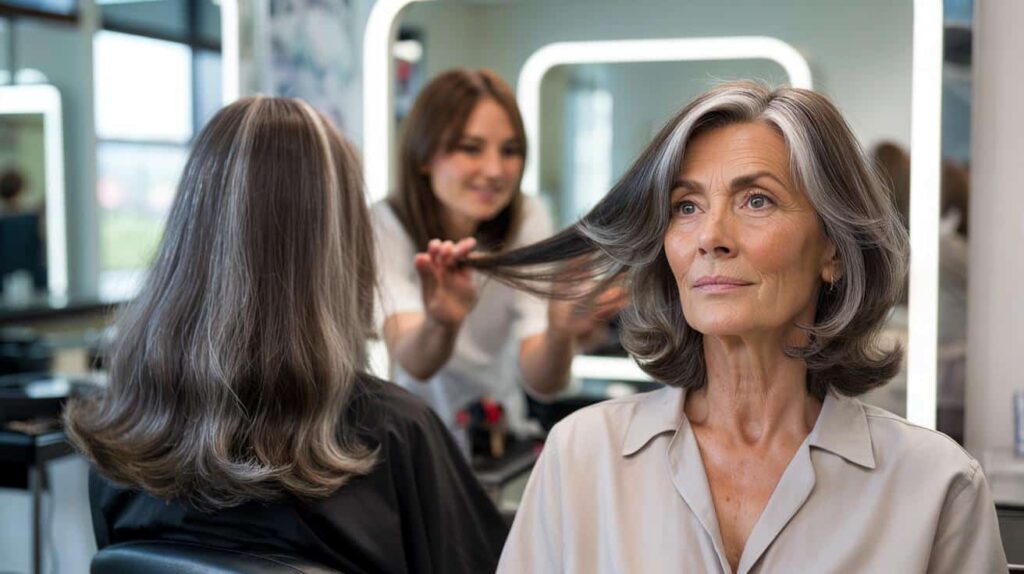
Around us, blow dryers roared, foils crinkled and women in their 60s walked out with sharp bobs, airy shags, modern pixies. She stayed stuck in 1993.
When the stylist gently suggested a chop, the woman stiffened. “I’ve always had long hair. Short hair is for old ladies.”
The stylist caught my eye in the mirror. And that’s when she said the quiet part out loud.

Why long hair after 60 can secretly age your whole face
Ask any seasoned hairstylist off the record and you’ll hear the same confession: the hardest clients to transform are not the ones with thinning hair, but the ones clinging to old length.
Past 60, hair changes texture, density, even color pattern. That mermaid length you loved at 35 can suddenly drag your features down, framing every line and hollow. Long, one-length hair pulls the eye vertically, creating a visual weight that makes cheeks look sunken and jawlines softer than they really are.
The result? A strange contrast between a mature face and a teenage silhouette. And not in the way we hope.
Stylist Marie, 49, remembers a client named Denise who walked into her Paris salon with hair halfway down her back. Denise was 67, sharp-witted, a retired lawyer who dressed in immaculate navy suits. From the neck down, she looked current. From the neck up, the story was different.
Her hair was thin at the temples, bulky at the ends, dyed too dark, always worn in the same low ponytail. “I feel invisible,” Denise told her. “People talk to my hair, not to me.” After a long talk, she agreed to a layered shoulder-length cut with soft face framing and a slightly lighter shade.
Three months later, she came back with a new complaint: “Now strangers think I’m 58. It’s very irritating,” she laughed, ordering the same cut again.
What professional hairstylists see that we don’t is the geometry of aging. Long, heavy hair pulls everything down: eyebrows, cheekbones, even the corners of the mouth by illusion. Shorter or mid-length cuts open the neck, reveal the clavicles, and put the focus back on the eyes.
On social media, “ageless beauty” is often portrayed as keeping your hair long forever, like a rebel badge against the passage of time. In real life, stylists quietly say the opposite: **the more you hang on to your old length, the more you signal that you’re stuck in the past**.
It’s not that long hair is forbidden after 60. It’s that flat, dense, untouched length rarely works with the way real hair and real faces evolve.
The pro-approved way to keep your hair modern after 60
The first move is not to go short. The first move is to go lighter and airier. Most pros start by lifting the visual weight: gentle layers, a few face-framing pieces, a softer color, sometimes taking the ends up just to the collarbone.
Think “movement” before “drastic change”. A long bob that brushes your shoulders, with a slightly undone finish, instantly looks fresher than waist-length hair that hangs like a cape. Airy bangs that skim the eyebrows can blur forehead lines and lift the whole upper face.
A good rule hairstylists use: hair should not be significantly longer than the width of your shoulders unless it’s naturally dense, shiny and healthy from root to tip.
Still, many women over 60 sit in the chair and whisper the same fear: “I don’t want old-lady hair.” Stylists hear it daily. The irony is that the very thing meant to avoid that label – clinging to old, long hair – is what most often creates that out-of-touch effect.
The real “old” look isn’t length. It’s outdated styling. Super straight, stiff, helmet blowouts. Flat, too-dark color with no dimension. Hair scraped into the same tight bun every day because anything else feels like too much work. Let’s be honest: nobody really does this every single day.
The sweet spot? A cut you can rough-dry in ten minutes, run a brush through, and still look intentionally put together.
“Women think I’m attacking their identity when I suggest cutting length,” says Lucia, a London stylist with 30 years behind the chair. “I’m not. I’m cutting the tether to the version of themselves from twenty years ago. Once they see their cheekbones again, they rarely go back.”
- Mid-length magic: Aim between chin and collarbone for an instant lift that doesn’t feel drastic or “mom cut”.
- Soft edges, not blunt walls: ask for texturizing at the ends so the hair doesn’t form a harsh frame around the face.
- Color that breathes: add subtle highlights or lowlights instead of one flat shade, especially if you’ve been dying it very dark.
- Light on the face: side-swept bangs or face-framing layers that start around the cheekbones can blur lines and draw attention to the eyes.
- *Low-maintenance styling:* cuts that look good air-dried with a bit of cream tend to look modern, real and alive.
When long hair still works after 60 — and when it quietly doesn’t
There are women in their 60s and 70s who look incredible with long hair. Usually, their hair is naturally thick, they embrace some grey, and their cut has visible shape. The length is a choice, not a souvenir.
They get small trims regularly. They allow a bit of texture and movement. They update the way they part and style it. The hair collaborates with their age instead of fighting it. **The plain truth is that you don’t have to cut everything short – you just have to stop pretending your hair hasn’t changed.**
The women who look “off” are often those whose hair and face are telling two different decades.
We’ve all been there, that moment when you see an old photo and feel a sting: “I used to look like that.” Hair length becomes a talisman against that loss. Which is why the phrase “You should cut it” can feel like an attack instead of an upgrade.
What stylists wish more women knew is that a modern cut after 60 is not about erasing age. It’s about aligning how you actually look with how you actually feel now. Friends start saying “You look so rested” rather than “Did you do something?”
Sometimes, the shock isn’t that a shorter or mid-length cut makes women look older. It’s that it suddenly reveals just how much their old hair was doing them no favors at all.
| Key point | Detail | Value for the reader |
|---|---|---|
| Length adds visual age | Heavy, long hair can pull features down and highlight lines | Helps you understand why your usual style no longer “works” |
| Shape beats length | Mid-length cuts with movement modernize without feeling drastic | Offers a realistic path to change without shock or regret |
| Update, don’t erase | Soft layers, lighter color and easy styling align hair with who you are now | Gives you tools to look current while still feeling like yourself |
FAQ:
- Question 1Do I have to cut my long hair short after 60?
- Answer 1No. You don’t have to go short, but most pros suggest at least moving toward mid-length and adding movement, layers or a softer color so the hair doesn’t drag your features down.
- Question 2What if my hair is very thin — will shorter hair make it worse?
- Answer 2A well-cut shorter or mid-length style often makes fine hair look thicker, because the weight is removed from the ends and the shape is built closer to the head.
- Question 3Is long grey hair aging or modern?
- Answer 3It depends on the cut and condition. Long, yellowed, frizzy grey hair can look tired, while a shaped, shiny, layered grey mane can look striking and contemporary.
- Question 4How often should women over 60 get their hair cut?
- Answer 4Most stylists recommend every 6–10 weeks for short to mid-length cuts, and every 8–12 weeks for longer styles, just to keep the outline fresh and the ends healthy.
- Question 5What do I tell my stylist if I’m scared of a big change?
- Answer 5Say clearly: “I want to look fresher, not different. Let’s change shape slowly.” Ask for photos, start by taking off a few centimeters, and agree that you’ll reassess together in the mirror.
