
At 9:15 on a Tuesday morning, the salon is already humming when Marie walks in, tugging gently at her ponytail. She’s 57, elegant, successful, and visibly annoyed with the way her hair seems to flatten the second she sits down. In the mirror, the light catches the scalp at her crown she swears “wasn’t showing last year.” She jokes about needing a hat glued to her head, but her eyes don’t joke.
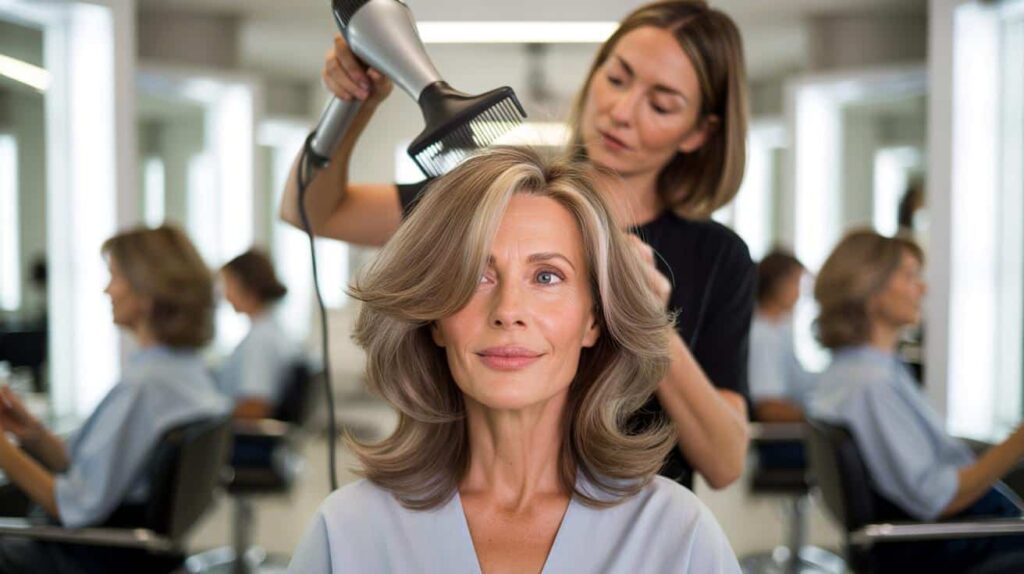
Her stylist, Lena, wraps a cape around her shoulders and does what she always does first: she grabs a comb, lifts a section, and just listens.

Somewhere between the sighs and the small talk, a pattern emerges.

Fine hair after 50 behaves like it’s following new rules.
“My hair used to behave. Now it just collapses.”
Lena swears she can spot the “over-50 fine hair” haircut from across the room. The outline is familiar: lengths that hover somewhere around the shoulder, ends that look feathery instead of full, roots that lie flat even when the rest of the hair is puffed up with mousse. The owner usually sits down with the same opening line: “My hair has changed, and nothing works anymore.”
Hormones, stress, years of coloring, a bit of life fatigue in the follicles — it all shows up on the head first. The hair isn’t just finer, it’s often drier and more fragile, so all the tricks that worked at 35 suddenly weigh it down. That’s when frustration starts to grow faster than the hair does.
One of Lena’s regulars, a 62-year-old lawyer, used to come in with screenshots from Instagram: thick blowouts, bouncy layers, volume for days. Each appointment ended with the same sentence: “Why doesn’t mine look like that?” After a few visits, Lena started keeping her own “before and after” photos.
On paper, the lawyer’s routine was textbook “volume”: volumizing shampoo, thickening mousse, round brush, hot rollers at home. In reality, the hair was collapsing by lunchtime. When they stripped the routine back — lighter products, a shorter cut grazing the jaw, and a different blow-dry angle — the next photo looked like someone had quietly doubled her density. The hair hadn’t changed. The strategy had.
Once hair passes the 50 mark, its biology shifts gears. The growth phase of the hair cycle shortens, some follicles miniaturize, strands emerge thinner, and the scalp’s natural oil production slows. That combination means hair can look flat at the root but parched at the ends, a frustrating paradox that leads many women to overload with products “for volume” and “for moisture” at the same time.
The problem is that most generic volume tips ignore age-related changes. The big blow-dry you copied from a 20-year-old on YouTube just won’t translate on a finer, more delicate fibre. A stylist who works with real clients day in, day out, learns that what truly works after 50 is less about fighting your hair and more about editing everything that suffocates it.

The cut and styling tricks that actually give lift
When Lena talks about volume after 50, she doesn’t start with products. She starts with scissors. For fine hair, she avoids heavy, blunt lengths that hit the shoulders and flip in weird directions. The sweet spot she keeps returning to is somewhere between the cheekbone and just above the collarbone, with soft, internal layers that don’t thin the ends.
She also plays with the “weight line” — where the eye perceives fullness. For some clients, a slightly shorter nape and longer pieces around the face suddenly create the illusion of density. This isn’t about drastic chops or chasing trends. It’s about shaving off the dead weight that literally drags the root down and then shaping the rest so the hair can stand up on its own.
The other battlefield is the bathroom. Lena says most of her clients with fine hair after 50 wash “either too often or not nearly enough,” and both can flatten the hair. If the scalp gets oily, the first centimeters of hair stick to the head like clingfilm. If it’s overloaded with dry shampoo and residue, it collapses for a different reason.
She guides them toward a gentle, lightweight shampoo and a conditioner that never touches the roots — mid-lengths and ends only, and not in big dollops. Then comes her non-negotiable: a heat protectant with a bit of hold, applied root to tip, followed by a blow-dry where the roots are lifted away from the scalp with fingers or a brush. It’s a simple ritual, but repeated consistently, it beats any “miracle” spray. *Hair responds more to routine than to wishful thinking.*
The hardest part, she admits, is un-teaching the habits picked up over decades. Some clients still cling to heavy oils and thick serums, convinced they’re “nourishing” their hair, when they’re actually smothering it. Others fry their roots with irons trying to “smooth out frizz,” only to remove the little natural volume they had.
“After 50, my goal isn’t to give you a younger person’s hair,” Lena says. “My goal is to give your hair its best possible version right now — lighter, lifted, and touchable, not shellacked into place.”
- Light layers, not thinning – Ask for soft, internal layers that keep ends looking full instead of razored or excessively texturized.
- Root-focused styling – Apply mousses, sprays, or root-lifters mainly at the base, not all over, to avoid weighing down fragile lengths.
- Volume-friendly washing rhythm – Aim for a balance: clean enough for lift, spaced enough to avoid stripping already-fragile hair.
- Gentle heat, strong direction – Blow-dry with the airflow pointing from root to tip while lifting the hair up and away from the scalp.
- Product minimalism – One good volumizing product + one light protector beats a crowded shelf of half-used, heavy formulas.
Letting your hair tell the truth about you, not your age
Fine hair after 50 can feel like a betrayal. You wake up one day and realize your ponytail is half the size it used to be. Yet the clients who end up the happiest aren’t the ones who fight this change the hardest; they’re the ones who start treating their hair as a new material to play with. They accept that the rules have changed, then learn those new rules with curiosity rather than panic.
There’s something quietly powerful in that shift. When Marie returned to the salon a month after her “lighter, shorter, smarter” cut, she didn’t bring screenshots. She brought selfies from a weekend away, hair a bit tousled, fringe falling just so. “I didn’t think about it once,” she said. That, for Lena, is the real win.

| Key point | Detail | Value for the reader |
|---|---|---|
| Rework the cut | Shorter, lifted shapes with soft layers instead of heavy, shoulder-hitting lengths | Instant visual fullness without needing extra styling time |
| Clean, light routine | Gentle shampoo, conditioner kept away from roots, minimal yet targeted products | Longer-lasting volume and less scalp show-through during the day |
| Root-centered styling | Blow-dry with lift at the base, moderate heat, and directional airflow | More natural height and movement, with less damage to fine strands |
FAQ:
- Question 1Is it better to go short with fine hair after 50?
- Answer 1Not automatically. Shorter cuts can create the illusion of thickness, but an ultra-short crop can also expose the scalp if it’s not carefully shaped. The key is removing excess length that drags the hair down while keeping enough around the perimeter to frame the face and diffuse any thin areas.
- Question 2How often should I wash my fine hair?
- Answer 2Most stylists suggest every 2–3 days for fine hair after 50, adjusting for your scalp’s oiliness. Daily washing can strip fragile strands, yet going too long can flatten roots with built-up sebum and product. Listen to how your hair looks on day two: that’s often the sweet spot.
- Question 3Do volumizing shampoos really work?
- Answer 3They help, but they’re not magic. A good volumizing shampoo will feel light, rinse clean, and leave no waxy film. Paired with a lightweight conditioner and proper blow-drying, it can noticeably boost lift. Used alone with heavy styling creams, its effect is almost erased. Let’s be honest: nobody really does this every single day.
- Question 4Can coloring damage my already fine hair?
- Answer 4Yes, aggressive bleaching and frequent high-lift color can weaken fine strands further. That said, soft highlights, lowlights, or a slightly lighter overall shade can visually thicken hair by adding dimension. Talk to your colorist about gentler techniques and spacing out strong chemical services.
- Question 5Are supplements worth trying for fine hair after 50?
- Answer 5Supplements can support hair health if you have deficiencies, but they won’t turn naturally fine hair into thick hair overnight. A blood test with your doctor is the most honest starting point. If iron, vitamin D, or other markers are low, targeted supplements plus a good cut and routine can work together more effectively than any “miracle pill” alone.
