
The sun hits the living room window at just the wrong angle.
You step back with your spray bottle and paper towel, convinced you’ve done a good job… then the light shifts, and there they are. Long, ghostly streaks, cloudy marks, that weird foggy patch you swear wasn’t there a second ago.
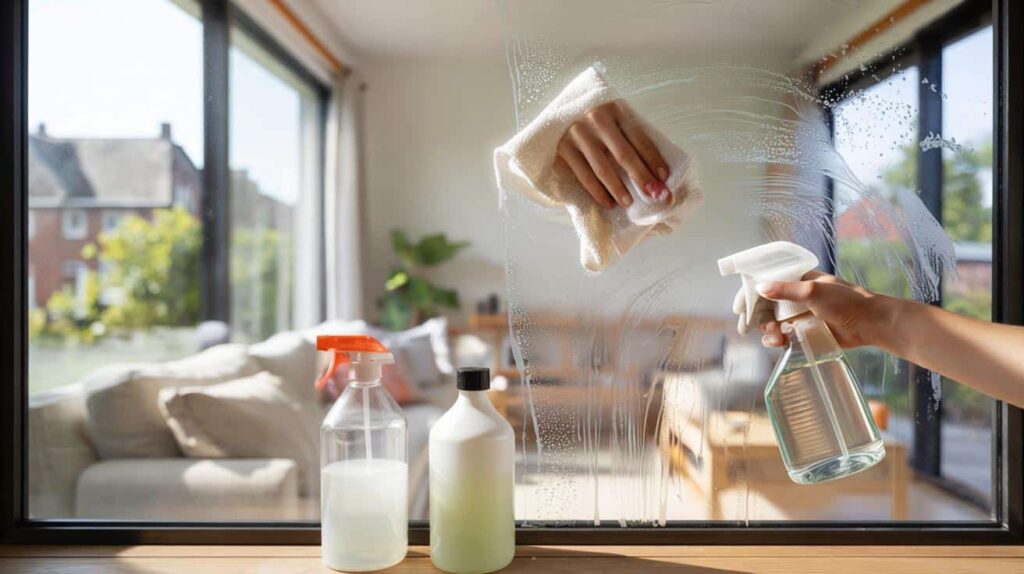
You rub harder, add more product, change paper towels. Somehow, it gets worse. The glass looks smeared, your arm hurts, and you quietly resent whoever invented windows this big.
 The baking tray in the oven will shine like new: a clever trick without expensive chemicals
Then a tiny thought appears: what if the problem isn’t you, but what you’re using?
And what if the solution is already in your kitchen cupboard?

Why your windows always look streaky (even when you “clean” them)
Most people clean windows in a rush, between two emails or just before guests arrive. Spray, swipe, done. From a distance, the glass looks fine.
Then daylight exposes every swirl of product you’ve left behind.
Modern glass cleaners are full of additives: perfumes, dyes, agents that promise “shine” but dry unevenly. On a sunny day, they evaporate too fast.
So instead of clean glass, you get dried residue drawn in circles or zigzags across the pane.
The funny part is, your window probably isn’t filthy.
It’s just covered in a thin cocktail of old product, dust and fingerprints fighting each other on the surface.
Picture this. Saturday morning, first coffee, you finally decide to deal with the balcony door that your kids and dog treat like their personal canvas.
You spray an expensive blue cleaner from the supermarket, wipe with paper towel, and step back.
From inside, it almost looks okay. Then you open the door, look at it from outside, and your heart sinks.
The glass is striped. Every wipe mark is visible. When the sun passes behind a cloud, it looks normal again, and you start doubting your own eyes.
We’ve all been there, that moment when you wonder if spotless glass only exists in magazines and hotel lobbies.
At home, our windows tell the true story of steam, cooking, fingers, and time.
There’s a very simple reason streaks are so stubborn: product and water never dry at the same speed.
Tap water carries minerals. Cleaning sprays carry surfactants and fragrances. Your cloth brings lint and old dirt.
When all of that lands on the glass, it doesn’t vanish. It sits.
As the water evaporates, minerals and residues stay exactly where your hand passed. The more you “polish”, the more you redistribute them.
*The secret isn’t to rub harder, it’s to use fewer ingredients on the glass in the first place.*
Strip the mix down to one active product and one absorbent tool, and the streaks no longer have anything to cling to.
The zero-streak method with stuff you already have
Walk to your kitchen. Chances are you already own the most underrated window cleaner on earth: white vinegar.
The cheap, boring bottle sitting behind the oil.

Here’s the method that quietly changes everything.
Fill a spray bottle with one part white vinegar and one part warm water. No need to be ultra-precise, roughly half and half is fine.
Spray lightly on the glass, not until it’s dripping. You just want a mist.
Then grab an old cotton T‑shirt or a microfiber cloth and wipe from top to bottom in straight lines, not circles.
Finish with a quick, dry pass using another cloth or a clean old pillowcase.
The acetic acid in vinegar cuts through grease and old product, and because there’s no perfume or soap, nothing is left to draw streaks.
There are a few traps that sabotage the best efforts.
First, the sunny-day reflex. Bright light seems perfect for cleaning, yet it’s your worst enemy for windows. On warm glass, your mixture dries too fast and leaves marks.
Try late afternoon or a grey day. The glass stays cooler, your vinegar mix has time to work, and you’re not racing the sun.
Second trap: paper towels. They shred, they fluff, and they drink too much product. You end up pushing damp paper fibers around, not actually drying the glass.
Old cotton, an outdated dish towel, a clean sock turned into a mitt – they all work better.
Let’s be honest: nobody really does this every single day. So when you finally tackle your windows, give yourself tools that help you win the battle, not lose it.
Sometimes the simplest solutions feel almost suspicious. One reader told me, “I stopped buying fancy glass sprays, used vinegar and an old T‑shirt, and my husband thought I’d changed the windows. Not the product, just the method.”
- Use a basic vinegar mix1 part white vinegar, 1 part warm water, in a spray bottle you already own.
- Wipe in straight linesTop to bottom or left to right, not circles, so you actually remove dirt instead of chasing it.
- Pick the right clothOld cotton or microfiber, washed without fabric softener, gives a cleaner, lint-free finish.
- Avoid hot sun on glassClean on cooler, cloudy moments so the mixture doesn’t flash-dry and streak.
- Finish with a dry passOne last, light wipe with a dry cloth makes the glass crisp and clear.
When clean windows start to change how your home feels
Something quiet happens when your windows are actually, honestly clean.
The room feels lighter even if you haven’t changed the decor. Dust on the shelves matters less because daylight suddenly flows in without hitting a dirty filter.
You start noticing details outside again – the neighbor’s cherry tree, the texture of the bricks opposite, the way the evening sky turns almost violet in spring.
All from a bottle of vinegar and a cloth that had a second life.
What’s striking is how fast the mind forgets the effort and remembers the effect. Next time you drag your feet at the idea of window day, you’ll recall that calm moment when the glass went from dull to invisible.
Not a transformation sold in a glossy ad, but one you produced with what was already in your home.
Maybe that’s the real appeal of this simple trick. It reminds you that small, low-cost gestures can quietly upgrade your everyday life – and that the barrier to a clearer view is rarely as thick as it seems.

| Key point | Detail | Value for the reader |
|---|---|---|
| Vinegar beats fancy sprays | White vinegar + warm water dissolves grease without perfumes or dyes | Cheaper, fewer chemicals, far fewer streaks on glass |
| Right moment, right tools | Clean on cool, non-sunny hours with cotton or microfiber cloths | Less frustration, faster drying, a clearer finish in one pass |
| Simple method, big visual impact | Top-to-bottom lines and a final dry wipe make glass look “invisible” | Brighter rooms, more natural light, and a home that feels fresher |
FAQ:
- Can I use any kind of vinegar to clean windows?White distilled vinegar works best because it’s clear and doesn’t stain. Apple cider vinegar can leave a faint tint and smell stronger, so it’s not ideal for glass.
- Will the vinegar smell stay on my windows?The smell is sharp for a few minutes, then disappears as the glass dries and the room airs. If it bothers you, open a window while cleaning or dilute the mix a bit more.
- Is vinegar safe on car windows and mirrors?Yes for glass, no for screens or tinted films. On cars, spray onto a cloth instead of directly on the windshield to avoid contact with dashboards or electronics.
- Can I add dish soap to the mixture?A single drop can help for very greasy kitchen windows, but too much soap brings back the streak problem. For regular dirt, vinegar and water alone are usually enough.
- How often should I clean my windows to avoid heavy buildup?Once every two or three months per side is already a big step up from “whenever I remember”. Interior glass in kitchens may need it more if you cook a lot.
