
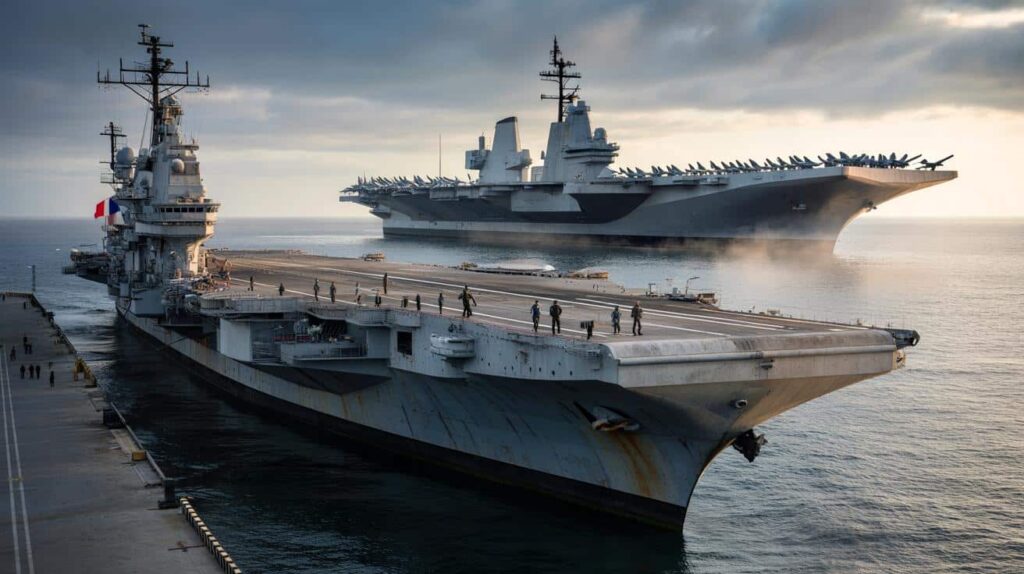
On a grey winter morning in Toulon, the French aircraft carrier Charles de Gaulle cuts a strange figure. She is still massive, still bristling with radar domes and antennas, still carrying the invisible weight of two nuclear reactors deep in her steel belly. Yet the sailors moving along the flight deck already talk about her in the past tense.
There is a quiet sense of countdown in the air.
 8-Second Challenge: Can Your Eyes Catch All 3 Differences in This Tricky Grandma and Dog Scene
Down below, in a cramped office smelling faintly of coffee and metal, a young officer points at a blueprint pinned to the wall: a sleeker silhouette, longer, broader, buzzing with new tech. His voice drops a notch when he says the words that are now reshaping the French Navy: “PANG – Porte-Avions Nouvelle Génération.”

France is getting ready to bury its most powerful warship.
And to give birth to something even more ambitious.
The end of an era for the Charles de Gaulle
On paper, the Charles de Gaulle still looks terrifying. Nuclear-powered, 261 meters long, capable of launching Rafale jets loaded with missiles into distant skies. At sea, her silhouette is a floating slice of French pride, a steel island waving the tricolour in waters from the Mediterranean to the Indian Ocean.
But ships age like athletes. At some point the knees creak, the reflexes slow, the scars accumulate. The Charles de Gaulle, commissioned in 2001, is entering that phase where each new refit buys only a few more good years. The French Navy knows it. So do its allies. And so, quietly, planning for her “funeral” has already begun.
If you stand at the harbor fence in Toulon on deployment day, you see the story in human scale. Families wave from the pier as the carrier eases out, horn booming across the bay. Children point at the fighter jets chained to the deck, at the sailors in dress whites lined up along the rail.
Many of those sailors weren’t even born when the ship was laid down in 1989. They grew up with the Charles de Gaulle as a background TV image: planes striking ISIS, jets escorting coalition bombers over Afghanistan, patrols in tense gulfs where rival navies eye each other in silence.
For them, this warship is not a symbol from a history book. It is a workplace, a village, a floating piece of France they have slept, argued, laughed and been scared on.
Yet cracks show through the paint. Systems that were cutting-edge at the end of the Cold War now need constant nursing. The carrier’s catapults and arresting wires demand meticulous care. Its nuclear heart requires heavy, specialized maintenance campaigns that pull the ship out of service for long stretches.
Strategists in Paris have done the math: by the late 2030s, the Charles de Gaulle will be at the edge of safe and efficient operation. Pushing beyond would mean spiraling costs and growing risk. A navy that wants to project power into the 2050s and beyond cannot lean on late-20th-century hardware.
So the choice is brutal but simple: retire a national icon. Design something that can survive the world the next generation will actually face.
The nuclear “monster” that will replace her
The outline of that “something” is already clear. The future PANG will be longer – about 305 meters – and heavier, displacing around 75,000 tons. Two new-generation nuclear reactors from France’s energy giant will feed an electric heart, driving advanced propulsion and a web of high-power systems.
The French are not hiding their ambition: this should be **Europe’s most advanced aircraft carrier**. A platform tuned from day one for drones, electronic warfare and cooperative combat in an ocean filled with sensors, satellites and long-range missiles. Where the Charles de Gaulle was modernised step by step, PANG is being drawn directly into the digital battle space.
On the blueprints, nothing looks monstrous. On the open sea, it will.
One of the big jumps comes from flight operations. PANG is being designed to host France’s future fighter, the NGF (Next Generation Fighter) of the FCAS program, alongside Rafales and a swarm of unmanned aircraft. To launch these heavier, more demanding machines, the French are going for EMALS-style electromagnetic catapults, like those on the latest US carriers.
That means no more steam plumbing from the reactors to the catapults, but a clean surge of electric energy accelerating jets to takeoff speed. It also opens the deck to lighter drones that steam catapults handle badly. The carrier becomes a kind of mobile tech hub, capable of flinging piloted fighters and small robotic scouts into the same sky.
On a stormy night in mid-ocean, that flexibility can mean the difference between seeing first and being seen first.

From a strategic angle, PANG is France doubling down on its role as Europe’s only nuclear-powered carrier operator. The UK’s Queen Elizabeth-class carriers are impressive, but they run on conventional fuel and use short takeoff ramps for F-35Bs. PANG aims at a different league: long-range, high-tempo, heavy-jet operations for weeks without refuel, backed by nuclear endurance.
That endurance is not just about prestige. It signals that France intends to remain a blue-water power, able to escort merchant routes, reassure partners in the Indo-Pacific, and plug deeply into American-led coalitions without being a junior member.
*In a world where sea lanes can be choked with one missile salvo, a carrier like this is both a shield and a message.*
How you “bury” a nuclear carrier – and what comes next
You don’t scrap a nuclear-powered warship the way you junk an old ferry. The burial of the Charles de Gaulle will be a cold, meticulous process. First, a final major refit around 2027–2030 to carry her safely through her last operations. Then years of planning for defueling, dismantling, and handling of radioactive sections under some of the strictest rules in the world.
French engineers already did something similar with their old nuclear submarines. The core idea is simple: safely remove the fuel, cut the reactors and contaminated zones into transportable blocks, and treat or store them under controlled conditions. The rest of the ship – miles of steel, cables, machinery – is recycled like any large industrial structure.
Not very glamorous. Absolutely essential.
There is a human cost too, which is rarely discussed in the glossy announcements. A warship’s death scatters its community. Sailors retrain for shore jobs or new ships. Some technical trades vanish with the old systems. The small rituals of life on board – the coffee at a particular corner, the superstition about a hatch, the way a certain corridor smells – evaporate the moment the ship falls silent.
We’ve all been there, that moment when a workplace closes or a building you know too well gets demolished. A carrier is the same feeling, multiplied by 2,000 people and 40,000 tons of memories. That sense of loss will be very real in Toulon the day the Charles de Gaulle hoists her flag down for the last time.
Let’s be honest: nobody really thinks about a ship’s retirement when they watch the flyby on TV.
The French Navy brass like to remind their crews of a hard truth: “We are not in the business of nostalgia. We are in the business of readiness.”
So PANG is already shaping training, budgets, and industrial choices today. French shipbuilder Naval Group must coordinate dozens of companies, from radar specialists to drone-makers, to create a floating ecosystem where everything talks to everything. Cybersecurity teams are involved from day one.
For ordinary readers, the technical jargon can feel abstract. That’s where a simple mental checklist helps to understand what’s really changing:
- More power: two powerful reactors feeding electric systems rather than old-style steam loops.
- More aircraft: capacity for up to around 30 fighters plus drones and support planes.
- More range: months at sea with only food and aviation fuel limiting deployments.
- More integration: designed from scratch to operate with satellites, frigates, submarines and allied air forces as one network.
The “monster” label starts to make sense when you see how many layers of power and information are stacked into one hull.
A French carrier in a fractured world
When you pull back from the harbor and look at the map, the story stops being about just one ship. The Atlantic, Mediterranean, Red Sea, Indian Ocean, South China Sea – all of these are now busy chessboards where navies shadow each other and commercial ships cross invisible front lines.
PANG is France betting that big, expensive carriers still matter in this messy game. Critics argue that long-range missiles and cheap drones make them too vulnerable, floating targets waiting to be overwhelmed. Supporters reply that, without mobile airfields, you are blind and toothless far from home. The debate will not end when steel is cut in the yard.
What is certain is that a nuclear carrier in 2050 cannot afford to be a solo diva. It will live or die surrounded by submarines, escorts, satellites and algorithms fighting in silence.
 Quick Healing Method for Dry Cracked Heels Using Simple Kitchen Ingredients That Actually Work
| Key point | Detail | Value for the reader |
|---|---|---|
| PANG replaces Charles de Gaulle | New nuclear carrier planned for late 2030s service | Grasp how France is renewing its military power at sea |
| Next-gen tech on board | Electromagnetic catapults, drones, future fighters | Understand why this ship is billed as **Europe’s most advanced carrier** |
| Strategic signal | Long-range, nuclear-powered, coalition-ready platform | See how one vessel reshapes Europe’s role in global security |
FAQ:
- Will France operate two carriers at the same time?For a short overlap, yes. The goal is to have PANG ready before Charles de Gaulle fully retires, so France keeps at least one carrier available during the transition.
- When will the Charles de Gaulle actually be retired?Current planning points to the late 2030s, depending on her condition after the next major refit and on PANG’s construction timeline.
- How much will PANG cost?Official figures evolve, but we are talking about several billion euros spread over decades, including research, construction, and the ecosystem of escorts and aircraft.
- Is PANG only for French missions?No. Like Charles de Gaulle, it is designed to work tightly with NATO and EU partners, especially the US and UK, during joint operations and crisis responses.
- Could other European countries join the project?Some cooperation on technologies and aircraft is already underway, yet the carrier itself remains a national program, built around French nuclear expertise and industrial choices.
