
You’re brushing your teeth, staring at your reflection, and suddenly your chest feels tight. Nothing “bad” happened. No fight, no crisis, no tragic email. Yet your eyes sting and your brain buzzes like you just ran a marathon made of feelings.
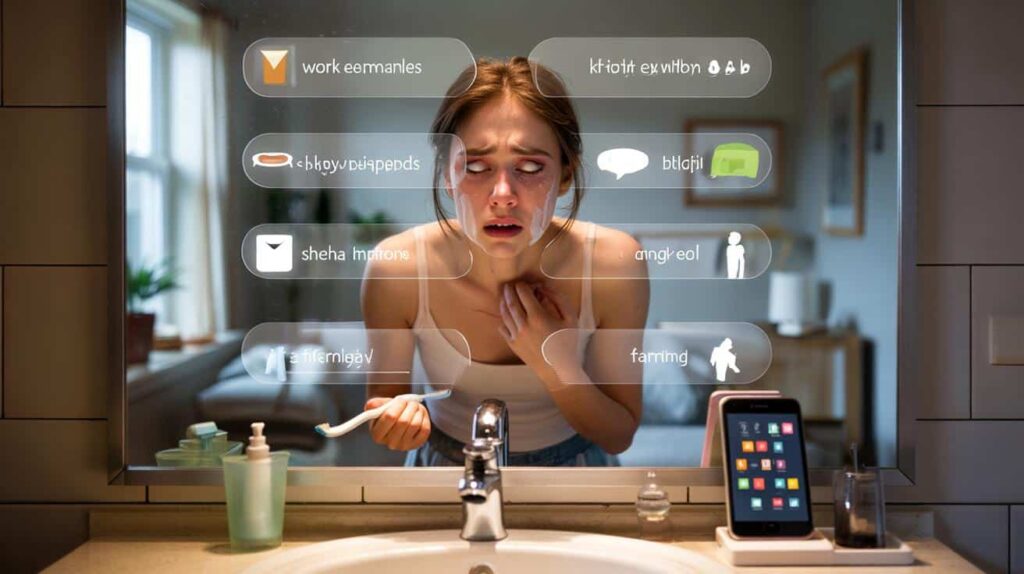
You scroll your phone to distract yourself, but every reel, every headline, every tiny notification feels too loud. One comment stings. A casual text sounds passive-aggressive.

There’s no obvious trigger you can point to. Just this vague, heavy fog of “too much.”

You wonder if you’re going crazy, or if everyone else is secretly walking around like this too.
The truth is less dramatic, and much stranger.
When your emotions crash without warning
Some days, your emotional life feels like a browser with forty tabs open. None of them loud enough to explain why you’re about to cry in the supermarket aisle, but all of them running in the background, eating up your energy.
You’re answering a simple work email and your throat tightens. A colleague asks “Got a minute?” and your body reacts like there’s a fire alarm.
Nothing is technically wrong, yet everything feels like “too much.”
*Your nervous system knows something your conscious mind hasn’t caught up with yet.*
Think about Lena, 32, who kept saying “I’m fine, just tired.” She had a stable job, a decent apartment, a partner she loved. No obvious drama.
Yet she would find herself tearing up while waiting for the bus, or feeling irrationally angry when someone walked too slowly in front of her.
One evening, she burst into tears because the dishwasher wasn’t stacked “correctly.” That was the moment she scared herself.
When she finally talked to a therapist, they unpacked the last year: a quiet breakup with a close friend, months of low-grade work pressure, news headlines that never stopped, three family health scares. Nothing huge alone. Together, they formed a silent emotional landslide.
This is what emotional overload often looks like today: not one big explosion, but a long, slow leak.
Our brains are wired to scan for visible threats. A car crash, a big argument, losing a job. What they aren’t great at spotting is the drip-drip-drip of micro-stressors: messages, expectations, silent worries, unfinished conversations, constant noise.
So your mind says, “I’m fine, I’m lucky, others have it worse.”
Your body replies with insomnia, irritability, random tears, and that huge lump in your throat when the barista gets your order wrong.
That mismatch between “my life is okay” and “my feelings are screaming” is exactly where emotional overload hides.

How to gently turn down the volume
One of the most effective things you can do when you feel emotionally overloaded with no clear reason is surprisingly simple: name what’s going on, even if it feels vague.
Sit down somewhere quiet for three minutes. No phone, no music. Ask yourself, out loud if you can: “If my body could talk right now, what would it say?”
Then write down single words, not complete sentences: “Tired.” “Underestimated.” “Scared about money.” “Lonely in my relationship.” “Worried about the news.”
You don’t need a beautiful journal or a perfect morning routine. A random note in your phone at 11:37 p.m. works just as well.
Many people skip this step and jump straight into distraction. Binge-watching, doomscrolling, cleaning the kitchen at midnight, working longer hours “to catch up.”
The overload doesn’t go away; it just goes underground. That’s usually when the “mystery” meltdowns arrive, in the car, in the shower, in the break room.
There’s a quiet courage in admitting: “I’m not okay and I don’t fully know why yet.” You don’t have to diagnose yourself. You just need to stop gaslighting your own feelings.
Let’s be honest: nobody really does this every single day. Yet doing it once a week can already change the emotional temperature of your life.
Sometimes the most radical thing you can do is to treat your invisible feelings as real as a broken bone — even if no one else can see the X‑ray.
- Mini check-in ritual (5 minutes)
Sit, breathe slowly, scan your body from head to toe, and ask: “Where is the tension?” Then ask: “What might this tension be trying to tell me?” - Noise audit
Look at one day of your life: notifications, chats, meetings, kids, TV, podcasts. Cut out one source of emotional noise for a week and see what shifts. - One safe person
Choose one person you can text with a simple code word like “fog” or “maxed” when you feel overloaded. No need to explain everything; their job is just to respond with presence, not solutions. - Micro-boundaries
Say “I can answer this tomorrow” once a day. Or “I need 10 minutes” before engaging in a tough conversation. Small boundaries train your nervous system to trust you. - Professional backup
If the overload lasts for weeks, feels scary, or affects your basic functioning (sleep, appetite, work), talking to a therapist or doctor is not overreacting — it’s maintenance.
Living with a full heart in a loud world
Feeling emotionally overloaded for “no reason” isn’t a personal flaw. It’s often a natural response to living in a world where our nervous systems are constantly pinged, poked, and pulled in twenty directions.
You’re not broken because you cry when a song catches you off guard, or freeze when your calendar fills up, or feel like screaming in a perfectly normal family dinner. You’re noticing the bill for months or years of emotional debt coming due.
What would change if we treated those moments not as failures, but as messages? As tiny alarms saying: “Something in your life needs room, softness, or support.”
Maybe it’s one honest conversation you’ve been avoiding. Maybe it’s the news app you need to delete. Maybe it’s admitting that “I’m fine” hasn’t been true for a long time.
There’s a strange kind of relief in saying, “Yes, I’m overwhelmed — and I’m allowed to be.”
You don’t have to solve your whole life tonight. You just need one small gesture of care that tells your overloaded self: I see you, and I’m not going to leave you alone with this.
 8-Second Challenge: Can Your Eyes Catch All 3 Differences in This Tricky Grandma and Dog Scene
| Key point | Detail | Value for the reader |
|---|---|---|
| Emotional overload can be invisible | Often caused by accumulated micro-stress, not a single big event | Reduces shame and confusion about “overreacting” or crying “for no reason” |
| Listening to your body is data, not drama | Physical cues (tension, fatigue, irritability) reveal hidden emotional needs | Helps readers spot early warning signs before a full emotional crash |
| Small rituals create emotional breathing space | Quick check-ins, micro-boundaries, and one safe person to contact | Gives concrete, doable tools to feel less overwhelmed day to day |
FAQ:
- Why do I feel overwhelmed when “nothing bad” is happening?
Because your brain tracks more than conscious events. Ongoing low-level stress, unresolved emotions, constant notifications, and background worries all add up. Your body often reacts to the total load, not the last straw.- Is this the same as anxiety or depression?
They can overlap, but they’re not always the same. Emotional overload can be a reaction to life circumstances, while anxiety and depression are clinical conditions. If your mood, sleep, or appetite stay disrupted for weeks, talk to a professional.- Should I just be “tougher” and ignore it?
Pushing through might work briefly, but the feelings usually come back louder. Ignoring overload is like ignoring a low fuel light — the car keeps moving, until it doesn’t. Listening early is actually the braver move.- What if I feel guilty because others “have it worse”?
Two realities can exist together. You can care about other people’s pain and still honor your own limits. Comparing suffering doesn’t heal anyone; caring for yourself often gives you more capacity to care for others.- When is it time to seek help?
If emotional overload interferes with daily life, relationships, work, or basic self-care, or if you feel hopeless, numb, or unsafe with yourself, that’s a clear sign to reach out — to a therapist, doctor, helpline, or someone you trust. You don’t need a dramatic reason to deserve support.
