Those golden fruits that end up in a crumble, a tart or straight in your lunchbox have travelled a long way. Along that journey, they meet sprays, soil, handling and humidity. A quick rinse under the tap feels reassuring, yet it often leaves behind more than you think.
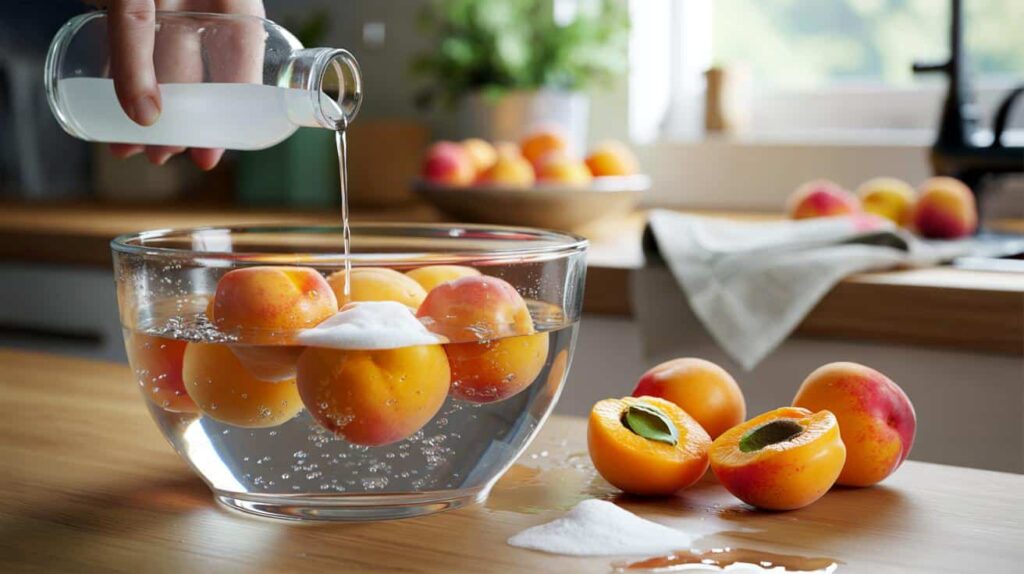
Why apricots need more than a quick rinse
Apricots sit in orchards, lorries and displays with their skin constantly exposed. Even organic fruit can carry traces of soil bacteria or fungal spores. Conventional apricots, depending on how they’re grown, may also hold residual pesticides on the surface.

Their delicate fuzz does not help. That slightly velvety texture acts like a tiny sponge, catching fine particles that plain water struggles to dislodge. When those fruits go into the fridge still carrying spores or bacteria, the cold slows growth but does not stop it. As soon as the temperature fluctuates a little, mould can spread fast.

Washing apricots properly reduces surface pesticide residues and delays the appearance of mould, giving you safer fruit that keeps longer.
This does not mean you have to scrub them harshly or peel them. The goal is a deeper clean that respects the fruit while making its skin far less friendly to microbes.
The two cupboard staples that change everything
The most effective method does not rely on an expensive gadget or a trendy “detox” spray. It relies on two products sitting in most kitchen cupboards already: white vinegar and baking soda.
Used correctly, they form a simple, low-cost cleaning bath. Each acts in a different way on the surface of the fruit.
How white vinegar helps
White vinegar is naturally acidic. This acidity can help detach certain pesticide residues that are sensitive to a low pH, making them easier to rinse away. The liquid also flows into the tiny hairs and creases of the apricot skin, areas that a brief splash of water barely reaches.
After soaking, a very thin acidic film can remain on the peel, even if you do not taste it. That slightly acidic environment is less welcoming for many common bacteria and moulds, which prefer neutral conditions to grow.
White vinegar does not “sterilise” fruit, but it pushes the balance away from what bacteria and mould spores like.
What baking soda brings to the mix
Baking soda, by contrast, is mildly alkaline and has a gentle abrasive feel. On apricot skin, the tiny grains help loosen dust, dried mud and some residues that cling to the fuzz.
Its alkalinity can also disturb the outer membranes of some microorganisms sitting on the surface. Combined with the mechanical effect of water, this helps wash them away more efficiently than water alone.
The key is moderation. You do not need a thick paste or vigorous scrubbing, just enough baking soda dissolved in the vinegar-water bath to boost the overall cleaning effect.
Step-by-step method: the best way to wash apricots
Here is a practical routine you can follow as soon as you come back from the market or supermarket.
- Start with a brief rinse: run the apricots under cool water to remove visible soil or grit.
- Prepare a large bowl: pour in three parts cold water to one part white vinegar.
- Add baking soda: for about ten apricots, stir in one teaspoon of baking soda until dissolved.
- Soak the fruit: place the apricots in the solution, making sure they are fully submerged.
- Wait about 15 minutes: let the mixture work on residues while you unpack other groceries.
- Rinse thoroughly: remove the apricots and rinse well under running water to remove vinegar and baking soda.
- Dry carefully: pat them dry with a clean tea towel or kitchen paper before storing.
A short soak in a vinegar and baking soda bath, followed by a good rinse, is currently one of the most efficient home methods for cleaner apricots.
This same approach can be adapted to many other fruits and vegetables with edible skin, from peaches to peppers. Just avoid using it on very porous or fragile items like mushrooms, which absorb too much liquid.

How this routine affects freshness and mould
Cleaning apricots like this does more than tackle pesticide residues. It also changes what happens during storage. By reducing the initial load of microbes on the skin, you slow the appearance of those tell-tale mould spots near the stalk or at small bruises.
Drying the fruit after washing matters just as much. Excess moisture trapped in containers or fruit drawers creates local pockets of humidity where mould thrives. A quick pat with a cloth reduces that risk without damaging the fruit.
| Step | What it does | Effect on mould |
|---|---|---|
| Vinegar soak | Lowers pH, helps detach residues | Makes surface less friendly to microbes |
| Baking soda | Loosens dirt, destabilises some cells | Reduces spores and bacteria on the skin |
| Thorough rinse | Flushes away particles and solution | Removes dislodged germs and residues |
| Careful drying | Limits standing moisture on fruit | Slows mould spread during storage |
Common mistakes when washing apricots
Many habits feel reassuring but do little for safety or freshness. Some may even do harm.
Washing too far in advance
Washing apricots days before you plan to eat them, then putting them back damp into a closed container, often backfires. The bath reduces microbes at first, but any remaining spores now enjoy a slightly humid greenhouse.
For fruit you want to keep several days, wash them, dry them properly, then store them in a breathable container or on a plate lined with paper. For apricots you plan to eat the same day, wash them just before serving.
Using soap or dishwashing liquid
Household soaps and detergents are meant for plates, not for fruit. They can leave residues that are not intended for ingestion. Some are hard to rinse completely from porous or fuzzy skins.
Stick to food-safe solutions: water, vinegar and a small amount of baking soda are enough for domestic use.
What this method can and cannot do
No home technique will remove every trace of every pesticide, especially substances that have penetrated beneath the skin. The vinegar and baking soda soak mainly targets what sits on the outer layer.
Peeling offers an extra margin if you are particularly concerned, but you lose much of the fibre and some nutrients concentrated near the skin. Many people choose to keep the peel and rely on thorough washing, especially when buying from trusted growers.
Practical scenarios in your kitchen
If you buy a large crate of apricots to make jam, you can soak them in several batches using the same proportions of water, vinegar and baking soda. Wash, rinse and pit them straight away, then freeze or cook. In this case, a slightly shorter soaking time, around 10 minutes, can be enough because the fruit will be heated during cooking.
For snack-sized portions, prepare the cleaning bath in a salad bowl as soon as you get home. Let the apricots soak while you put away chilled items. By the time you have finished with the fridge, your fruit is ready to rinse, dry and set out in a fruit bowl.
Extra tips for safer and tastier apricot habits
Two notions often mentioned in food safety around fresh produce are “residue” and “cross-contamination”. Residue refers to any substance that stays on the surface after harvest: pesticides, dust, soil. Cross-contamination happens when microbes from one item transfer to another, usually via hands, knives or chopping boards.
This means your cleaning routine works best when your hands and utensils are also clean. Wash your hands before handling fruit, and avoid cutting cleaned apricots on a board used for raw meat or unwashed vegetables.
Finally, think about combinations. Pairing cleaner apricots with yoghurt, granola or nuts gives you a snack that is not just safer, but also more satisfying and nutritionally balanced. In baking, washed and well-dried apricots release their juice more predictably, which helps tarts and clafoutis bake evenly without soggy patches.