
The numbers on the thermostat are stubbornly clear: 21°C. Cozy, on paper. Yet your toes are numb, your shoulders stay tense, and you find yourself hovering near the kettle just for the steam. The radiators are on, the boiler isn’t complaining, and still the chill hangs in the air like an uninvited guest.
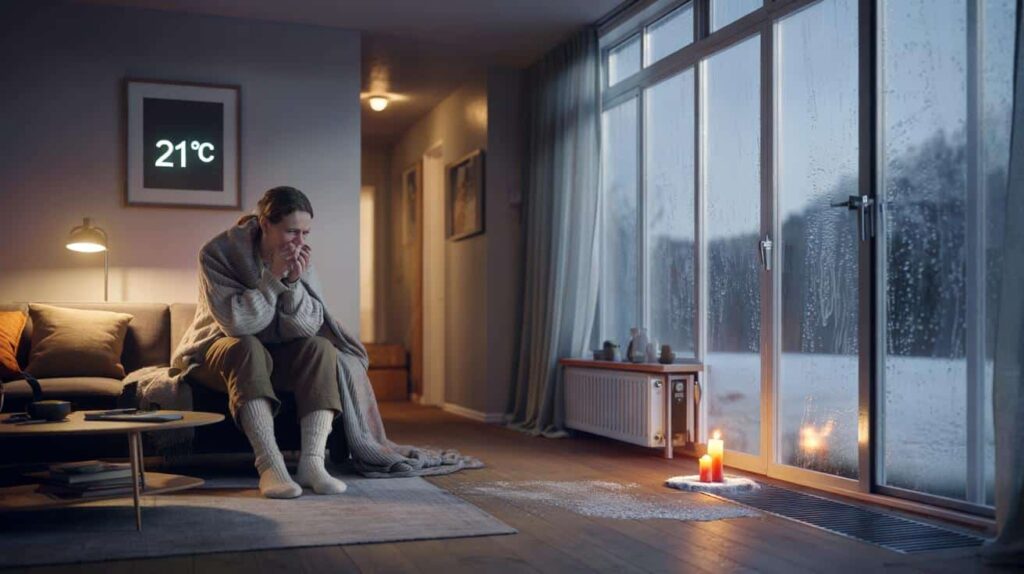
You pull on a second sweater, then a blanket. You start to wonder if you’re imagining it, or if your house is quietly betraying you this winter.

The thermostat says “all good.”
Your body says otherwise.
 Achieve Fuller Thicker Brows at Home With an Easy Lamination Routine That Delivers Results
When 21°C doesn’t feel like 21°C at all
That small screen on the wall gives a seductive illusion of control. You tap a button, the number jumps up, and you expect your whole home to obey. Yet the air around you tells a different story. Warm near the hallway, icy by the sofa. Fine in the kitchen, freezing in the bedroom.
The truth is, that single sensor often measures the comfort of one tiny corner of your life. Not your couch, not your bed, not the spot where your child plays on the floor. Just that one convenient piece of wall.
Picture this. The thermostat is in the warmest room: a narrow hallway, no windows, door always closed. The boiler does its job, the hallway hits 21°C quickly, and the heating shuts off with a satisfied click.
Meanwhile, you’re in the living room with big windows, a draft under the balcony door and a chilly exterior wall. Your thermostat is “happy.” You’re rubbing your hands together and thinking about buying yet another throw blanket. *The number looks fine, yet your bones don’t lie.*
What’s happening is simple physics dressed up as daily discomfort. Thermostats read air temperature at their location, not the temperature of your walls, floors, or the surfaces you actually touch. Cold walls radiate chill. Leaky windows let in draughts. Uneven insulation means one room hoards the heat while another bleeds it away.
Your body reacts to all these signals at once. So while the thermostat is calmly reporting an average, your skin is registering a mismatch between air temperature, surface temperature and hidden drafts. That gap is the cold you feel, even when “technically” you’re warm.
Small checks that change how warm your home really feels
Start with a simple walk-through test. Stand by each window for ten seconds. Then near each exterior wall. Then right in the middle of the room. Notice where your body instantly tenses, where a tiny stream of air hits your wrist or neck.
Do the same test at floor level. Sit where you normally watch TV. Then move to a chair. The air just 30–40 cm higher can be surprisingly warmer. If your ankles feel like they’re in a different climate than your chest, you don’t have a “thermostat problem”, you have a stratification and draft problem.
A surprisingly effective trick is the candle or incense stick test. Hold a lit candle or incense near window frames, door frames, plugs on exterior walls and around the baseboards. If the flame flickers sharply or the smoke drifts in one direction, air is sneaking in or out.

You don’t need fancy tools or a technician to start seeing your home differently. You just need a little curiosity, a steady hand, and a willingness to kneel by that suspiciously cold corner you’ve been ignoring for years.
Let’s be honest: nobody really does this every single day. We usually crank the thermostat first, complain second, and only ask questions when the bill arrives. Yet this is where the quiet savings and real comfort live.
“The thermostat is not a comfort guarantee, it’s just one opinion in a very noisy room,” explains one home energy auditor I spoke to. “Your walls, your windows, your habits – they all have a vote too.”
- Check where your thermostat is located – and how representative that spot really is.
- Look for cold surfaces, not just cold air: windows, corners, exterior walls.
- Notice your feet: cold floors are often your first honest signal.
Rethinking warmth: beyond the thermostat number
Once you’ve noticed the gap between what the thermostat says and what your body feels, it’s hard to unsee it. You start to realise that warmth is a whole ecosystem, not just a number on a screen. The texture of your flooring, the weight of your curtains, the way you close doors between rooms – all of it quietly reshapes your comfort.
Suddenly, a heavy rug under the coffee table feels less like decor and more like insulation. Thick curtains are no longer just a style choice, but a shield between you and that cold pane of glass.
There’s also the quiet emotional layer that slips into all this. Maybe you grew up in a house where the “good room” was always cold, or you were told not to touch the thermostat because of “the bill.” That history doesn’t vanish. It shapes how quickly you reach for a jumper or how guilty you feel pressing the little up arrow.
Sometimes what feels like a cold house is also a lifetime of learned restraint. You’re not just managing degrees Celsius, you’re negotiating with old stories about money, waste, and what “being reasonable” looks like.
You don’t have to overhaul your entire home or install a smart system tomorrow. Start small, with small truths. One room you actually warm properly instead of pretending it’s fine. One draft you finally seal. One conversation with the person who always says, “We can’t afford to turn it up,” and a look together at where the real losses might be.
A warmer home isn’t only about spending more. Often it’s about spending differently, noticing more keenly, and trusting your body at least as much as that glowing little number on the wall.

| Key point | Detail | Value for the reader |
|---|---|---|
| Thermostat location matters | Sensor often sits in a warmer hallway or room, shutting heating off too early | Helps explain why some rooms feel cold despite a “good” setting |
| Surfaces affect comfort | Cold walls, windows and floors lower perceived warmth even at 20–21°C | Shows where small fixes (rugs, curtains, sealing) can have big impact |
| Body > number | Listening to your physical sensations reveals drafts and uneven heating | Empowers you to adjust habits and layout, not just the thermostat |
FAQ:
- Why does 19°C feel fine at my friend’s house but freezing in mine?Because your two homes don’t store and radiate heat the same way. Better insulation, fewer drafts, warmer floors and thicker curtains all make 19°C feel much cozier.
- Is my thermostat broken if I feel cold at 21°C?Not necessarily. It may be accurately reading air temperature in its spot while you’re sitting in a colder area with drafts or cold surfaces.
- Should I move my thermostat?Placing it in a room you actually use, away from direct sunlight, drafts and heat sources, can give a reading closer to your real comfort.
- Will turning the thermostat up heat my home faster?No, most systems heat at the same rate. Raising the setting just makes the system run longer, not quicker, and can lead to higher bills without solving drafts.
- What’s the cheapest first step to feel warmer?Seal obvious drafts (tape or foam strips), add a rug where your feet get cold, and close doors to rooms you don’t need to heat fully.
