
On a foggy November morning in a quiet British cul-de-sac, the argument began over a bottle of mouthwash. Not politics, not parking, not even noisy teenagers. Mouthwash.
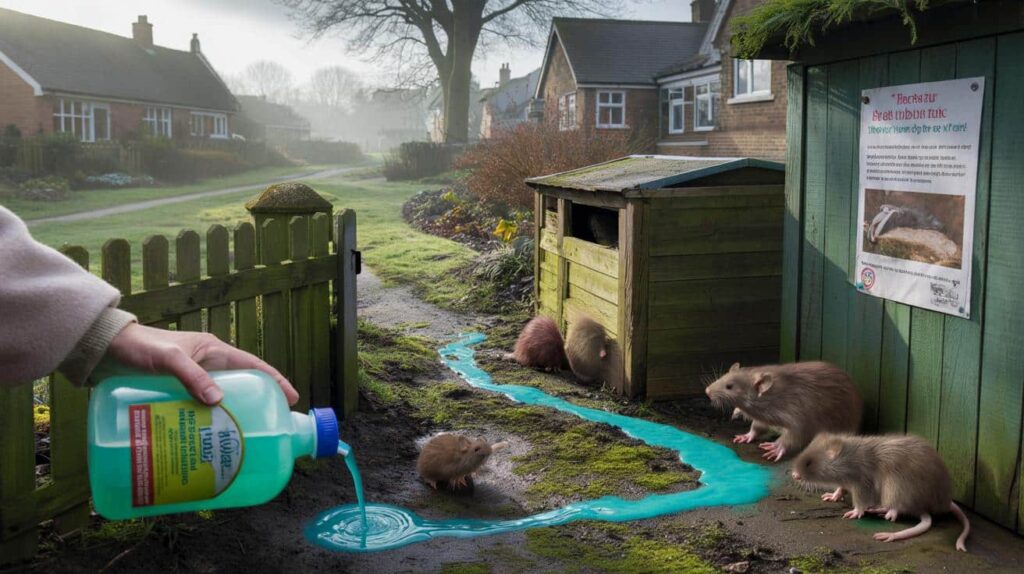
Behind a row of terraced houses, two neighbours stood by a compost bin, voices low but sharp. One clutched a bright blue bottle from the bathroom, the other had a leaflet from an animal welfare group. Between them, a narrow strip of garden that had suddenly become a winter shelter for rats.

Someone in the street WhatsApp group had shared a “genius hack”: pour mint mouthwash around the shed and flowerbeds and the rats wouldn’t come back. No poison, no traps, just a human bathroom staple.

Why a bottle of mouthwash is causing such a stir in winter gardens
The logic sounds almost too simple. Rats hate strong smells, people say, so splash a peppermint or spearmint mouthwash around the places they squeeze into in winter, and they’ll pack their tiny bags and leave.
Garden groups on Facebook are full of posts showing blue-green streaks along fence lines, under decking, around compost heaps. The photos look oddly domestic, like someone misplaced their bathroom on the lawn.
For some homeowners, especially those who hear scratching under the decking at night, it feels like a small miracle. A product already sitting by the bathroom sink suddenly becomes a frontline defense against overwintering rodents.
A soft solution to a hard problem.
In one village on the outskirts of Leeds, the trick spread faster than this year’s dahlias. It started with a single post in a local “Garden Help” group: “Tried this and not seen a rat in 10 days. Just cheap mint mouthwash from the supermarket.”
Within a week, neighbours were swapping photos and recipes. Some diluted it with water in a spray bottle. Others soaked cotton pads and tucked them behind planters and in shed corners. One retiree even painted minty rings around the base of her raised beds.
Then the pushback started. A nearby wildlife rescue centre posted a warning, asking residents to think about hedgehogs, birds, and the broader ecosystem. That post was shared even more, and the comments quickly turned into a showdown between “rat haters” and “animal lovers”.
The village noticeboard has never quite recovered.
At the heart of the debate sits a simple clash of instincts. On one side, people terrified of rats invading their homes as the weather cools. They picture gnawed wires, contaminated food, and the uneasy feeling that something is moving behind the walls at night. On the other side, there’s a growing awareness that urban wildlife isn’t just pests, it’s part of a fragile web that already struggles through winter.
Mouthwash feels like a clever compromise. Not a snap trap, not a block of poison, not a bloody mess in the morning. Just a scent barrier. Yet peppermint oil, alcohol, and detergents can be deeply irritating for small animals who navigate the world largely through smell.
A bathroom shortcut collides with an ethical question: where does gentle deterrence end, and quiet cruelty begin?
How the mouthwash method actually works in the garden
The method making the rounds is usually some version of the same three steps. First, identify the rat “highways” – little tracks through long grass, holes next to sheds, gaps under fences, droppings near compost heaps or chicken runs. Then, grab a strong-smelling mint mouthwash, ideally the cheap, no-frills kind stocked in most supermarkets.
People either pour a thin line of it directly along these routes or dilute it with water in a spray bottle, roughly one part mouthwash to two or three parts water. Sprayed along walls, around bins, and at the base of sheds, it creates a kind of invisible, nose-burning fence.
You repeat this every few days, especially after rain, because the smell fades shockingly fast. Let’s be honest: nobody really does this every single day.
It’s more “when I remember” than military routine.
The catch is that life in a real garden is never as tidy as a TikTok hack. One London family tried the mouthwash method around their compost heap after finding rat droppings near the back steps. The first week, it seemed to work. No new droppings, no rustling, no late-night darting shadows.
By week two, the rats had simply changed strategy. Instead of tunnelling by the compost, they moved under the neighbour’s decking, where the smell didn’t reach. Cue an awkward knock at the fence and a tense conversation about “your rats” versus “our garden”.
We’ve all been there, that moment when a clever fix in your own home quietly becomes someone else’s problem.
The minty line doesn’t respect property boundaries.
From a behavioural point of view, the trick isn’t magic at all. Rats have an extraordinary sense of smell and rely on it to map safe routes, find food, and detect danger. Blast their paths with harsh scents, and many will simply redirect, searching for quieter, less confusing corridors.

The mouthwash doesn’t “stop rats” so much as scramble their mental GPS. Some animal-rights advocates argue this creates ongoing stress for animals already struggling to survive the cold months. Supporters counter that it’s far gentler than poison baits that cause slow internal bleeding, or glue traps that leave animals panicking for hours.
*Both sides are technically right, which is what makes the issue so emotionally charged.*
A blue swirl of liquid has become a symbol of where each person draws the line.
Walking the tightrope between pest control and compassion
For gardeners wanting a middle path, pest experts often suggest starting long before the mouthwash comes out. Seal obvious entry points into sheds and under decking with wire mesh. Lift anything that creates dark, cosy tunnels – old timber, stacked pots, forgotten bags of compost. Store bird seed and pet food in metal or heavy plastic containers.
If you still reach for the mouthwash, use it as a final nudge, not the main strategy. Target only the precise routes you’ve spotted, not every corner of the garden. Avoid soaking soil or drenching areas where hedgehogs, frogs or ground-feeding birds might snuffle around.
Think of it as a scented roadblock, not a chemical carpet. The goal is to gently re-route, not to dominate every inch of outdoor life with the smell of your bathroom sink.
One of the biggest mistakes people admit, when they’re being honest, is letting fear make them overreact. A single rat sighting near the compost turns into a full-scale war: heavy poisons, blocked vents, stripped borders, and enough disinfectant to sterilise a hospital.
Then, once the panic eases, there’s often a pang of guilt. Did we go too far? Did we just wipe out the hedgehog that used to visit at dusk? Did we make the garden safer, or just quieter?
An empathetic approach starts by acknowledging that both instincts are valid. It’s perfectly human to feel afraid of rats. It’s just as human to feel uncomfortable with suffering, even when we tell ourselves it’s “only” a pest.
Some local councils and charities are now trying to reframe the conversation. Rather than shouting “don’t do this” or “you must do that”, they’re asking residents to pause and weigh up the full impact of every trick they try. As one urban wildlife worker put it to me:
“People don’t wake up in the morning wanting to hurt animals. They wake up wanting a home that feels safe. Our job is to help them see the space in between those two needs.”
From that space come more thoughtful choices, like:
- Using sealed compost bins instead of open heaps that become winter buffets.
- Reducing scattered birdseed on the ground, which invites rats as much as robins.
- Favouring **snap traps in closed boxes** over glue boards or secondary-poison baits.
- Calling a humane pest professional before resorting to DIY extremes.
- Talking openly with neighbours so the “solution” isn’t simply pushed next door.
A plain-truth sentence sits behind all of this: **we can’t have wildlife and zero inconvenience at the same time.**
Where does your garden ethics line quietly sit?
The mouthwash debate is really a mirror. On one side, there’s the instinct to defend the space we’ve worked hard to create – the decking we saved for, the veg beds we built, the shed we filled with tools and hopes. On the other, there’s an uncomfortable awareness that our tidy, fenced rectangle is part of a bigger landscape that doesn’t stop at the back gate.
When a cheap green liquid from the bathroom becomes the lightning rod for all that tension, it tells you something about our moment. We want easy fixes, soft outcomes, no visible harm. We also want to sleep at night without the sound of tiny feet in the walls.
In the end, a bottle of mouthwash on the lawn is less about science and more about stories. The story you tell yourself about rats: disease carriers, intelligent survivors, or something in between. The story you tell about your garden: fortress, sanctuary, or shared territory.
Some gardeners will quietly keep pouring minty lines along the fence, convinced it’s the most humane compromise they can live with. Others will switch to redesigning habitats and tolerating the odd rustle under the hedge, trusting that a rough balance will emerge.
What’s striking is how often people only talk about these choices when a neighbour complains or a local group explodes on social media. Maybe the real shift begins when we start having these awkward, honest conversations before winter drives the rats in. Not as accusations, but as open questions: what kind of garden do we want to live in, and what kinds of lives are we willing to push out of it?
The answer won’t be the same on every street. Yet the discussion itself might be the quietest, most powerful tool any of us bring outside this winter, right alongside that bright plastic bottle from the bathroom shelf.

| Key point | Detail | Value for the reader |
|---|---|---|
| Understand the mouthwash trick | Peppermint mouthwash disrupts rat scent trails rather than “killing” them | Helps set realistic expectations and avoid disappointment |
| Think beyond quick fixes | Combine scent barriers with sealing gaps, food control, and cleaner storage | Builds a more lasting, less stressful form of pest control |
| Balance safety and compassion | Consider wildlife impact, neighbour relations, and alternative methods | Supports choices that protect your home without needless cruelty |
FAQ:
- Question 1Does mouthwash really keep rats out of the garden?
- Question 2Is mouthwash in the garden dangerous for pets or wildlife?
- Question 3How often should I reapply mouthwash if I decide to use it?
- Question 4What are more humane alternatives to poisons and glue traps?
- Question 5How can I talk to my neighbours if their rat control methods worry me?
