Loongson’s new 12-core 3B6000 chip has finally been tested on Western soil, and the numbers show a wide gulf between China’s homegrown CPUs and the latest x86 parts from AMD and Intel. While the processor occasionally punches above its weight in specific Linux workloads, its low clock speed leaves it lagging badly in most tests.
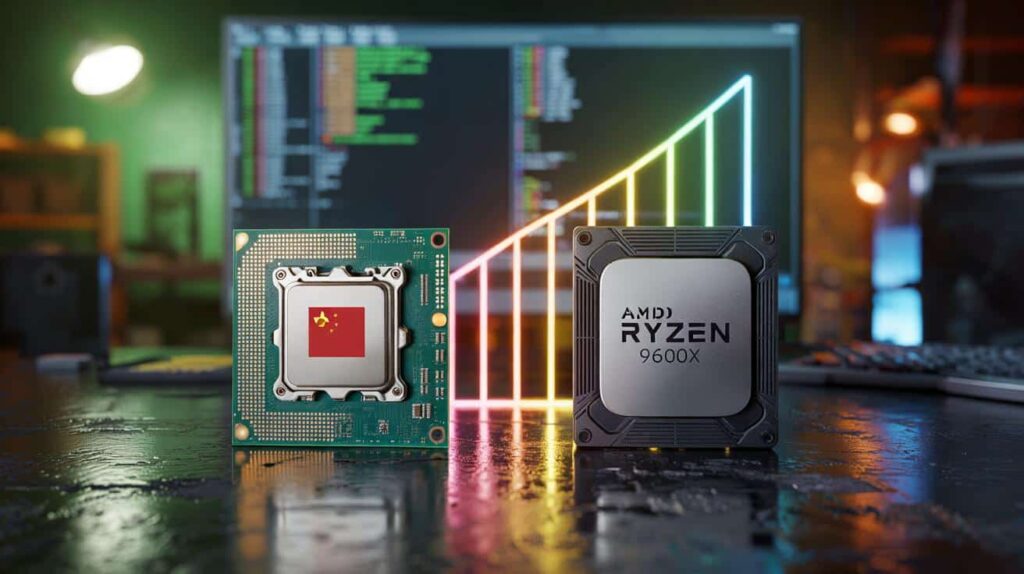
Loongson’s 12-core chip finally put through its paces
Loongson CPUs are usually confined to the Chinese market, used primarily in government systems and projects that avoid Western technology. A unit of the 3B6000, though, made its way to Linux performance site Phoronix through the Loongson Hobbyists Community, giving the rest of the world a rare glimpse at how this silicon actually performs.
 Quick Healing Method for Dry Cracked Heels Using Simple Kitchen Ingredients That Actually Work
- Two DIMM slots for system memory
- One M.2 slot for storage
- Two PCIe x16 slots
- A small number of USB ports
The system ran a Linux environment and was given a wide range of benchmarks, from synthetic CPU tests to real applications, including workloads that make use of AVX-512-like vector instructions.

The Loongson 3B6000 carries 12 cores but operates at around 2.5GHz, dramatically lower than the 5GHz-class clocks of current AMD and Intel chips.
Three times slower than a six-core Ryzen 5 9600X
The headline result is hard to ignore: across dozens of tests, the Loongson 3B6000 typically landed at the back of the pack, trailing far behind mainstream Western CPUs.
The comparison that stands out is AMD’s Ryzen 5 9600X, a six-core, 12-thread chip based on the Zen 5 architecture. Even with half the core count, the Ryzen part consistently outran Loongson’s 12-core design.
On average, the 12-core Loongson CPU performed roughly three times slower than the six-core Ryzen 5 9600X in Phoronix’s Linux benchmarks.
The only processor the 3B6000 reliably beat was a quad-core ARM chip inside the Raspberry Pi 500 — essentially a small-form-factor desktop built around Raspberry Pi hardware. That places Loongson’s current high-end desktop silicon in an awkward spot: above hobbyist-grade ARM boards, yet far behind mid-range consumer chips from AMD and Intel.
Where Loongson actually looks competitive
The story is not entirely bleak. In a handful of workloads, the 3B6000 managed to hold its own against far more established CPUs.
- C-Ray 2.0 (ray-tracing benchmark): Performance roughly on par with the Ryzen 5 9600X.
- OpenSSL 3.6 (cryptography): Results approaching Intel’s Core Ultra 5 245K in some operations.
- QuickSilver 20230818 (scientific-style workload): Edged past the Core Ultra 5 245K and delivered scores similar to Intel’s Core Ultra 9 285K.
These brighter spots suggest that the architecture’s instruction-per-clock (IPC) is not fundamentally weak. In select compute-heavy or vector-friendly workloads, Loongson’s design appears capable, provided the code aligns well with its strengths.
Low clock speeds are the main bottleneck
The biggest drag on the 3B6000’s performance is its clock speed. The chip runs at around 2.5GHz, roughly half the sustained clocks of many contemporary desktop processors.
Loongson’s LA664 cores are reportedly in the Zen 3 ballpark for IPC, but the 2.5GHz ceiling keeps total throughput far behind modern x86 rivals.
AMD’s and Intel’s current desktop chips often hold 5GHz or higher under turbo conditions. That frequency advantage alone can double performance, even when core counts are similar. When those x86 chips also bring higher IPC and more mature turbo behaviour, the gap widens further.
The result is a 12-core processor that, on paper, looks like a workstation-class part, yet behaves closer to a low-to-mid-range desktop CPU once clock speeds are factored in.

How the 3B6000 stacks up: a quick snapshot
| Processor | Cores / threads | Approximate clock | Typical relative performance* |
|---|---|---|---|
| Loongson 3B6000 | 12 / 12 | ~2.5GHz | Baseline (1x) |
| AMD Ryzen 5 9600X | 6 / 12 | Up to ~5GHz | ~3x faster |
| Raspberry Pi 500 ARM CPU | 4 / 4 | Lower than 3B6000 | Slower than 3B6000 |
*Relative performance based on broad Phoronix Linux benchmark comparisons, not a single test.
Loongson’s roadmap: LA864 aims for Raptor Lake-class performance
Loongson is not standing still. The company is already working on a new architecture called LA864, which has been pitched as a much more competitive design.
Future LA864-based chips are claimed to target performance similar to Intel’s 13th and 14th Gen Raptor Lake CPUs, with higher 3–3.5GHz clocks.
Those projected frequencies would still lag behind the 5GHz-plus peaks of AMD and Intel, but they mark a significant step up from 2.5GHz. If Loongson can keep or slightly improve IPC while raising clocks by roughly 20–40%, it could move from “Raspberry Pi plus” territory into a genuinely mid-tier desktop performance band.
Such chips are unlikely to appear in Western retail channels in large numbers. Their primary goal is strategic: giving China a domestically designed and manufactured CPU line that can run mainstream operating systems and applications without relying on imported x86 parts.
Why these benchmarks matter beyond raw speed
For everyday PC users in the UK or US, the 3B6000’s performance gap means one thing: this chip is not a rival to Ryzen or Core on pure speed right now. A six-core Ryzen 5 9600X will feel far snappier in gaming, content creation and general desktop tasks.
For governments and large organisations watching supply chains, the picture is different. A country that can ship its own 12-core desktop CPU, even a slow one, has more control over critical infrastructure. That matters for long-term planning, security and sanctions resilience.
There is also a software angle. Loongson uses its own instruction set, LoongArch, which aims to be broadly compatible with existing software stacks through translation layers and recompiled binaries. Each new CPU generation that runs Linux reasonably well makes it easier for local developers to port and optimise applications.
Context for non-specialists: what IPC and clock speed really mean
Two technical terms keep coming up in this story: IPC and clock speed. Both shape how “fast” a chip feels.
- Clock speed (GHz): How many cycles per second the CPU runs. Higher clocks usually mean faster performance, if everything else is constant.
- IPC (instructions per clock): How much useful work the CPU does in each of those cycles. A chip with strong IPC can outpace a higher-clocked rival with weak IPC.
Loongson’s 3B6000 seems to do a reasonable amount of work per cycle, reportedly similar to AMD’s older Zen 3 design. Yet at 2.5GHz, it simply runs fewer cycles each second, so total throughput is limited. That’s why a six-core Ryzen 5 9600X at around 5GHz can beat a 12-core Loongson chip by a wide margin.
For readers trying to choose hardware for Linux workloads, this case is a good reminder: chasing core count alone rarely pays off. A smaller number of fast, efficient cores can deliver better real-world performance than a bigger cluster of slow ones, especially in desktop and lightly threaded applications.