The sandstorm came in like a curtain being pulled across the sky. One moment the air above Inner Mongolia was a pale winter blue, the next it turned the color of old tea, thick with dust blown in from a desert that never seems tired of expanding. Sheep herders wrapped scarves tight over their mouths. A school bus stopped on the side of the road because the driver couldn’t see the next white line. The landscape felt like it was being erased in real time.
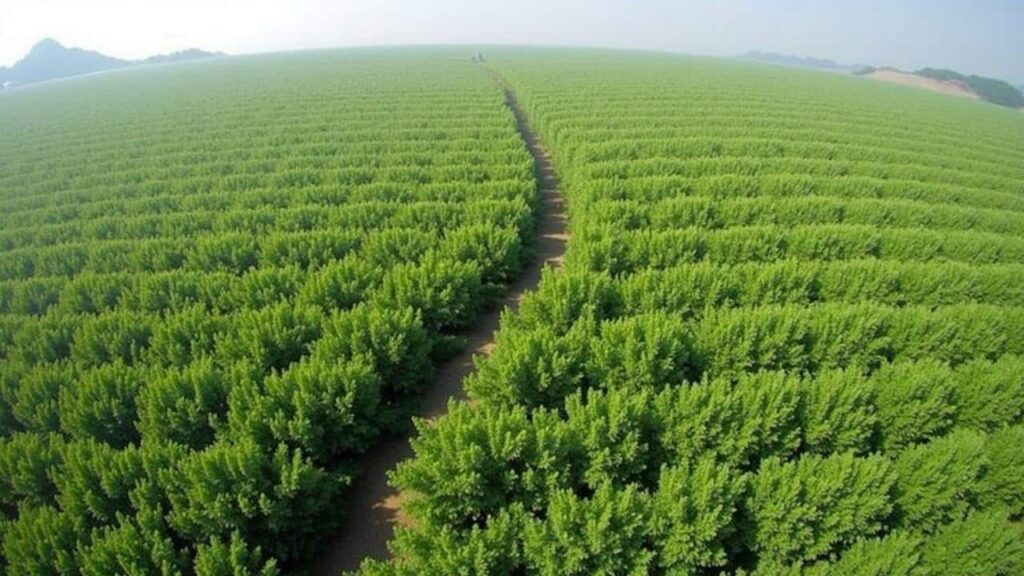
Then, a few kilometers further on, the storm seemed to hit a wall. Literally. A dark, irregular band of green appeared where satellite maps once showed beige. Lines of poplars and pines, awkward but stubborn, broke the wind and forced the sand to drop.
China calls it the “Great Green Wall.”
The planet is starting to wonder what to call it.
When a billion trees step between a desert and a city
From space, China’s Great Green Wall looks like a strange, leafy scar stretching across the north of the country. Nearly 4,500 kilometers of shelterbelts and plantations, stitched together over four decades, trying to hold back one of the most aggressive deserts on Earth. On the ground, it’s less majestic and more fragile. Thin saplings tied to wooden stakes. Farmers on motorbikes dragging water tanks. Rows of trees that look like soldiers permanently standing at attention.
The goal sounds almost mythical: plant billions of trees to stop the Gobi Desert from swallowing farmland, villages, even Beijing itself. And against all cynical expectations, parts of it are working.
Take the dusty city of Yulin, on the edge of the Mu Us Desert. In the 1990s, sandstorms buried roads and crept into living rooms, piling up against doors overnight. People stuffed wet cloth under window frames and still woke up with sand in their teeth. Those were the years when locals say you could “hear the desert breathing closer” every spring.
Today, satellite images show that the line of shifting dunes has pulled back in several sectors. Shrubs and trees are reclaiming dead land. Annual sandstorm days have dropped sharply. Farmers who once abandoned parched fields now grow maize and goji berries along newly stabilized dunes. It’s not a miracle. It’s an exhausting, state-driven grind.
Scientists measuring the results talk less poetically. They mention wind speed reductions, less dust in the air, and a slowing of “desertification fronts.” Some studies link up to one-third of northern China’s greening since 2000 directly to the shelterbelt projects. **The “green wall” doesn’t stop all storms, but it blunts their teeth.**
Yet under those same forests, biodiversity is often poor. Many plots are monocultures of fast-growing poplars or pines. Some trees die after a few years, victims of shallow roots and deep thirst. The wall is less a solid line than a patchwork of success and failure, stitched with political ambition.
Eco-rescue or authoritarian greenwashing?
The method, on paper, is disarmingly simple: plant trees where sand wants to move, then keep planting, year after year, until the wind runs into resistance. That means contour planting on dunes. Netting and straw checkerboards to trap sand. Low shrubs and drought-tolerant grasses on the front line, taller trees behind. It also means something less romantic: quotas. Village committees receive targets. Officials are evaluated on hectares restored. Bulldozers arrive, and entire hillsides are replanted in a single growing season.
The state calls it ecological civilization. For local cadres, it can feel closer to a box-ticking marathon.
On the ground, the human stories are more complex than any press release. Some farmers warmly embrace the project because tree-planting subsidies and new jobs patroling forests put food on the table. Others grumble quietly that good grazing pastures vanished under uniform rows of poplars that drink more water than they should. A few have seen old fruit orchards ripped out and replaced with politically favored species.
We’ve all been there, that moment when a big “green” initiative looks great on TV, then lands awkwardly on real lives. People in Ningxia and Inner Mongolia tell journalists they support fighting desertification. They also whisper that nobody asked them how best to do it.
Internationally, the Great Green Wall splits opinion. Some climate watchers see it as a rare piece of big, tangible good news: a country using its authoritarian muscle not just for highways and surveillance, but for ecological repair on a mind-bending scale. Others smell **authoritarian greenwashing** – a way to soften China’s image while coal plants still fire the country’s growth.
Let’s be honest: nobody really reads a billion-tree headline and calmly checks the fine print. Yet the fine print is where things get interesting. Studies show local temperatures slightly easing under tree cover. Soil moisture gradually improving. At the same time, scientists warn that overplanting thirsty species in arid zones can backfire, drying up groundwater. *The same project that slows the desert can stress the land in a different way.*
Reading the signals behind the “green wall” hype
If you want to understand whether this is eco-salvation or spin, start by looking at what types of trees go in the ground. Mixed stands with shrubs, grasses and native species suggest long-term thinking. Endless grids of identical poplars scream “quota first, ecology later.” Remote sensing images, open scientific papers and local testimonies are now accessible enough that anyone curious can dig into them.
Watch for words like “restoration” versus “afforestation.” One speaks of mending a damaged ecosystem. The other often just means putting trees where none truly belong.
Another signal: who benefits. If nearby communities get new income from non-timber forest products, better grazing conditions and less respiratory illness from dust, that’s genuine value. If they’re losing traditional grazing rights, paying fines for cutting saplings to heat homes in winter, or seeing sacred lands fenced off with no discussion, skepticism is healthy. Beijing’s narrative celebrates national glory. Villagers’ stories tend to be more ambivalent, mixing pride with frustration.
From afar, it’s tempting to paint everything in black and white – heroic climate action versus cynical propaganda. Reality almost always sits in the grey zone.
Even inside China, some scientists are unusually frank about the mixed record. They warn about water stress, poor survival rates and the danger of chasing “green coverage” metrics over ecological quality. At the same time, many acknowledge that without the project, entire regions would be closer to unlivable.
“Stopping desertification in northern China is not a choice between perfect ecology and no action,” a Beijing-based ecologist told me. “It’s a constant negotiation with a very aggressive climate, under a political system that loves big numbers.”
- Watch the mix of species – Diverse, native plantings usually signal deeper ecological planning.
- Follow the water – Healthy projects monitor groundwater and adjust planting when stress appears.
- Listen to locals – Their everyday reality cuts through official slogans faster than any press conference.
Living with a wall that breathes
The strangest thing about China’s Great Green Wall is that it’s both deeply local and planetary in its impact. A tree planted in Ningxia cools a single courtyard, shelters one flock, keeps one farmer from giving up that year. Multiply this small act by millions of people and decades of policy, and you start to bend the path of a desert. You also slightly tweak the global carbon ledger that headlines like to shout about.
The project doesn’t cancel China’s coal addiction. It doesn’t erase air pollution in big cities. It does quietly shift the baseline of what’s possible when a state decides to wrestle with a collapsing ecosystem.
The emotional tension is real. Part of us wants to cheer any sign that a major emitter is spending political capital on something green that isn’t just a slogan. Another part worries about clapping for forests we can’t fully see, in a country where critics don’t always speak freely. Both instincts are valid. This is the uncomfortable space where climate hope now lives: between genuine regeneration and well-produced narratives.
The plain truth is that the planet probably needs both scrappy community projects and heavy-handed mega-schemes if we want any chance of staying under climate chaos. The question isn’t whether China’s billion-tree wall is pure or tainted. It’s what we learn from its flaws and its wins – and whether we push our own governments to act with even a fraction of that scale, without the same cost in freedom.
| Key point | Detail | Value for the reader |
|---|---|---|
| Desert slowdown is real | Parts of the Gobi and Mu Us deserts are retreating where large-scale planting and restoration occurred. | Gives a grounded reason to feel cautiously hopeful about large-scale ecological repair. |
| Ecological risks remain | Monocultures and overuse of water threaten long-term forest health and local livelihoods. | Helps you see beyond green headlines and understand the trade-offs behind big climate projects. |
| Politics shapes the forest | Authoritarian power accelerates action but can silence local voices and complicate trust. | Offers a lens to read future “green mega-projects” with both openness and healthy skepticism. |
FAQ:
- Question 1Is China’s Great Green Wall actually stopping the desert?
- Answer 1In several regions, yes. Studies show reduced sandstorms, retreating dune fronts and increased vegetation cover, though results vary widely by location and planting quality.
- Question 2How many trees has China really planted for this project?
- Answer 2Official claims run into the billions, but exact numbers are fuzzy because some trees die, areas are replanted and different programs overlap under the “green wall” label.
- Question 3Does the project help fight climate change?
- Answer 3It does sequester carbon and improve local microclimates, but it doesn’t offset China’s massive fossil fuel emissions. It’s a helpful piece, not a silver bullet.
- Question 4Why do some experts criticize the tree planting?
- Answer 4They worry about monocultures, non-native species, water stress and a focus on short-term “green coverage” numbers instead of long-term ecosystem health.
- Question 5What can other countries learn from China’s green wall?
- Answer 5That massive restoration is technically possible and can work, but it needs local participation, diverse species and honest monitoring to avoid repeating the same mistakes.