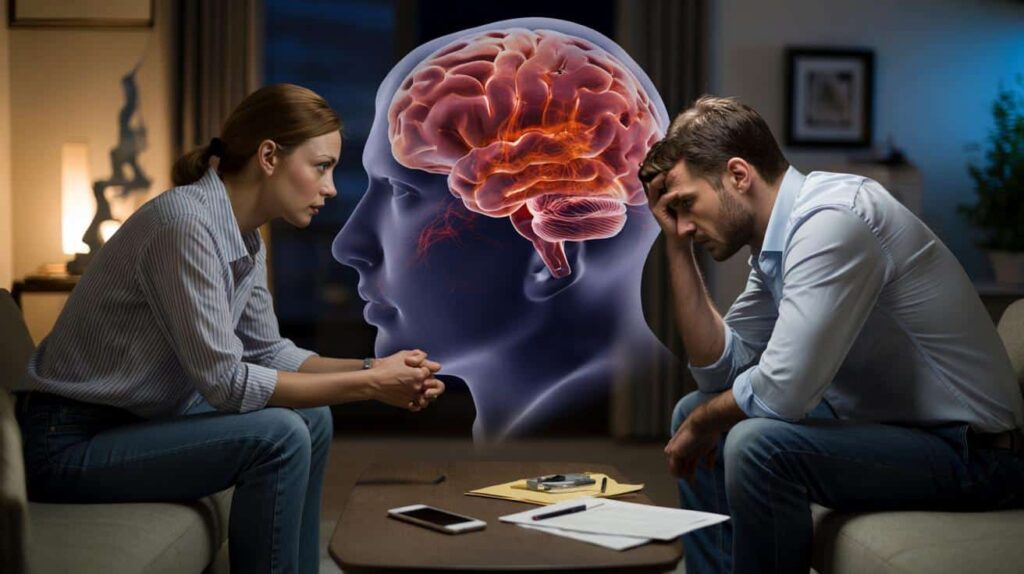
That reaction isn’t just about being “too sensitive”. New neuroscience research suggests the brain reads some romantic disputes as a genuine threat to safety and belonging.
When love feels like danger for the brain
Disagreements in a couple are supposed to be normal. One wants to go out, the other wants a quiet night. One comment about money or housework lands badly. Silence stretches, voices rise, someone slams a door.

What looks like a minor clash on the outside can feel like a storm on the inside. Heart pounding. Tight chest. Shaky voice. Urge to attack or to walk out. Many people then judge themselves: “Why am I overreacting?”

The brain doesn’t just hear “we disagree”; it often hears “my bond is at risk”. That shift changes everything.
A 2023 study published in the journal Social Cognitive and Affective Neuroscience sheds light on this reaction. The researchers showed that the brain processes social disagreement, especially with close others, through circuits that usually respond to threat, exclusion and pain.
Social misalignment: the brain’s early warning system
Scientists in the study looked at what they call “social misalignment”. This is the moment when your opinion, choice or judgment moves away from that of another person.
Using brain imaging and carefully designed tasks, they observed that the brain detects this misalignment extremely fast, within fractions of a second, long before people can put words to what they feel.
From the brain’s perspective, not being “in sync” with your partner is flagged as an alert, not a neutral difference of opinion.
A survival reflex inherited from the past
This sensitivity has deep evolutionary roots. For most of human history, survival depended on staying in the group. Repeated conflict or stubborn disagreement could mean exclusion, less protection and fewer resources.
In that context, tracking signs of mismatch with others wasn’t a luxury; it was a survival tool. Our nervous system still carries that bias. Even in a modern flat with locked doors and food in the fridge, a tense argument can activate circuits built for life-or-death situations.
Within a romantic relationship, this is amplified. A partner is not just another person; they’re often a key source of emotional safety, practical support and identity. So when disagreement appears, the brain can quickly slide from “we see this differently” to “I might lose this person”.
Why couple fights feel so overwhelming
The research also suggests that the brain doesn’t simply register disagreement as a yes/no signal. It measures the degree of misalignment and adjusts emotional intensity accordingly.
The bigger the perceived gap, the stronger the reaction. A simple “I don’t like that series you chose” triggers a small ripple. A clash over parenting, finances or loyalty can set off a wave.
Intense couple fights often feel disproportionate because the brain is treating them less like a debate and more like a threat to attachment.
From disagreement to social pain
Brain regions involved in social pain overlap partly with those used to process physical pain and fear. When a partner criticises, withdraws, or flatly rejects our view, those networks can light up.
The body then follows the script of threat response:
- Heart rate increases to prepare for action.
- Breathing becomes shallow or rapid.
- Muscles tense, sometimes clenching the jaw or fists.
- Attention narrows to what the other person is saying or doing “wrong”.
- Nuance disappears; the brain shifts into black‑and‑white thinking.
At that point, phrases like “you never listen” or “you always do this” show that the nervous system is on high alert. The goal unconsciously becomes self-protection, not mutual understanding.
How to calm the brain during an argument
If the brain hears disagreement as danger, trying to “win” the argument usually makes things worse. Each attack, eye-roll or sarcastic remark confirms the sense of threat and keeps the system switched on.
Arguments de-escalate faster when the brain feels the bond is safe, even while the disagreement remains.

Reassure the bond first, debate second
Neuroscience points towards a simple but demanding shift: reassure the relationship before tackling the content of the disagreement. That sounds abstract, so here are concrete phrases that can help calm the alarm:
- “We’re on the same side, even if we see this differently.”
- “I care about you; I’m just frustrated about this situation.”
- “I don’t want to hurt you; I want us to understand each other.”
- “We’re okay, the argument is not bigger than us.”
These messages tell the brain: “The bond is not under attack.” That makes it easier to stay curious rather than defensive.
The power of a strategic pause
Stepping away for a short time often gets labelled as avoidance, but from a neurobiological point of view it can be a smart move. When your system is flooded, logical thinking drops and old patterns take over.
A brief pause can allow the threat circuits to settle and the parts of the brain involved in reflection and empathy to come back online.
| Sign your brain is in threat mode | Possible regulation strategy |
|---|---|
| Racing heart, difficulty listening | Ask for five minutes alone to breathe and move |
| Urge to say something hurtful | Pause the conversation, write down what you feel instead |
| Going numb or shutting down | Say “I’m overwhelmed, I need a short break, I’ll come back” |
| Looping over the same accusation | Shift to “what do we both need right now?” |
When conflict doesn’t mean the couple is failing
Many partners assume that intense arguments prove the relationship is fundamentally broken. The neuroscience perspective offers a less catastrophic view.
Strong emotional reactions during conflict often say more about the brain’s alarm system than about the quality of the couple.
Two people can genuinely love each other and still have nervous systems that react sharply to disagreement. That is especially true for those with past experiences of rejection, chaotic relationships or bullying. For them, misalignment with a partner can echo earlier wounds and trigger an even stronger sense of danger.
On the flip side, couples who train themselves to recognise the early signs of threat mode tend to argue differently. They learn to say things like “I’m starting to panic; can we slow this down?” instead of “you’re impossible”. That small shift in language changes how both brains interpret the moment.
Key concepts worth knowing
Social pain
Social pain describes the hurt we feel when we are rejected, ignored or excluded. Brain scanners show that some of the regions activated during social pain overlap with those used when we experience physical pain.
That doesn’t mean heartbreak is “just in your head”; it underlines that the brain treats social bonds as vital to survival.
Attachment and arguments
Attachment theory, originally developed to describe the bond between infants and caregivers, also applies to adults in romantic relationships. People with a secure attachment style tend to assume that conflict is temporary and the bond will hold.
Those with more anxious or avoidant styles might read the same disagreement as proof of rejection or proof that closeness is dangerous. Their brains may go into threat mode faster and come back to calm more slowly. Recognising your pattern can help you interpret your reactions with more nuance and less self-blame.
Practical scenarios: what this looks like in daily life
Imagine a couple arguing about visiting in-laws for the holidays. On the surface, it is a scheduling issue. Underneath, each brain might be tracking deeper concerns:
- One partner hears: “My family doesn’t matter to you.”
- The other hears: “My needs never come first with you.”
Both nervous systems register threat: fear of losing status, care or priority. Voices rise, past grievances get added, and the original question disappears.
Using the neuroscience lens, they could pause and reframe:
- “I’m scared my family will feel rejected.”
- “I’m scared I’ll be pushed past my limits again.”
Once the fears are named, the brain often softens. The couple can then look for compromise instead of proof that one of them is “the problem”.
Arguments between couples will never be entirely comfortable. Yet understanding that the brain reads some of these clashes as real threats, not simple talk, opens space for less harmful, more repairable conflict. That shift can gradually turn frightening disputes into difficult, but manageable, conversations.