
The talking stops and birds become silent while an odd metallic coldness fills the air as the sky begins to darken. You check your watch and then look at the silly cardboard glasses everyone is wearing. You can sense it in the air around you. Everyone seems to be holding their breath together. All around the horizon you see what looks like a sunset in every direction even though the Sun is still overhead. Dogs start whining and streetlights turn on even though it’s the wrong time of day. Someone standing close to you quietly says just one word. “Whoa.”
When the Six-Minute Eclipse Will Occur and Why It Stands Apart
The date is already circled in red on astronomers’ calendars. On August 12 2026 a total solar eclipse will sweep across parts of the Northern Hemisphere but it’s the one right after that has specialists buzzing: a record-setting event in early August 2027 that will plunge parts of Earth into up to six minutes of total darkness. Those numbers matter. Most total eclipses offer one or two or maybe three minutes of totality if you’re lucky.

Six is an eternity in eclipse time. It’s enough for your eyes to adjust & your brain to stop saying this is weird and start quietly panicking at how wrong daylight suddenly feels. Think back to April 8 2024 when North America collectively stepped outside for a sky show. Highways jammed & parking lots turned into parties and small towns in Texas and Arkansas saw hotel rooms sell out a year in advance. That eclipse with up to 4 minutes and 28 seconds of totality was sold as a once-in-a-generation moment. People drove 10 hours for 90 seconds of darkness and you probably saw the viral videos: grown adults screaming or crying or suddenly whisper-quiet as the Sun snapped off like a switch.

The Best Places on Earth to Watch the Eclipse, Mapped
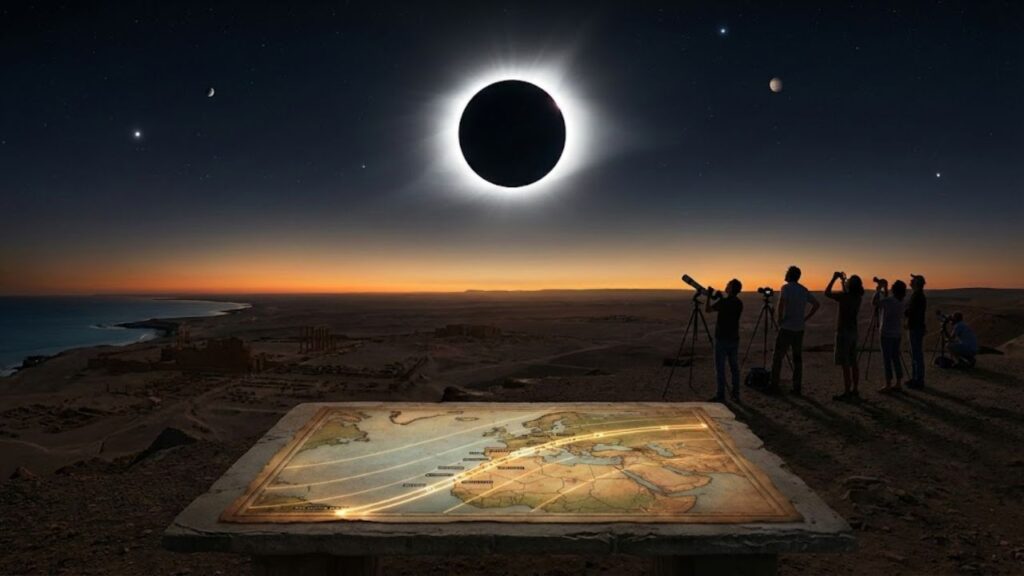
If you want the full experience of this eclipse that will give you goosebumps and stories to tell for decades you will need to travel. The path of totality for the 2027 eclipse cuts across southern Spain and then moves through the Mediterranean to North Africa and continues to Saudi Arabia and the Red Sea coast.
Egypt offers the most dramatic viewing opportunity. Near Luxor and Aswan the totality will last close to six minutes with the Sun completely blocked while positioned high in the sky. You could stand among ancient temples as daylight fades to deep twilight and watch the solar corona appear like ghostly fire around the darkened Sun. In southern Spain the eclipse will also create memorable scenes. The path reaches land near Cádiz and Málaga in the late afternoon which means the Sun will be lower on the horizon.
Totality there will be shorter at around 3 or 4 minutes but picture a Mediterranean coastal city suddenly plunging into darkness while the sea reflects the strange twilight glow. Cruise ships offer another viewing option. Companies are planning eclipse cruises across the Mediterranean that promise clear horizons and minimal light pollution with the ability to adjust position to stay under the path of totality.
Weather statistics favor Egypt and the Red Sea where August skies are typically clear and cloudless. Some travelers will chase the absolute maximum duration near Luxor where the Moon’s shadow will remain overhead for about six minutes and 23 seconds. That extra time allows you to truly absorb what is happening around you including the white streamers of the solar corona and planets becoming visible in the daytime sky while confused birds return to their nests.

How to Plan an Eclipse Trip Safely and Stress-Free
Pick your dream location first and then work out the details. If you want temples and history then Luxor is your place. For sand and sea try Hurghada or the Red Sea resorts. If you prefer urban energy then southern Spanish cities like Málaga or Cádiz will be buzzing on eclipse day. After you choose a general area you need to check the path of totality maps from reliable sources like NASA or timeanddate.com.
You want to find one thing: a location right in the middle of the dark band and not close to the edge. The next step is something people rarely mention in their social media posts: planning the practical details. Flight prices for popular eclipse locations usually increase 6 to 12 months before the event.
Hotels in those areas often double their rates once they know they are in the shadow path. Make your bookings early but leave room for changes. You might want to reserve a room in Luxor and have a backup option in Aswan or divide your time between a city and a smaller town. Weather is always unpredictable even in areas known for clear skies. Most people don’t plan eclipse trips regularly so making some adjustments at the last minute is normal even for experienced travelers.
Why Six Minutes of Darkness Can Change How We See the Sky
Ask anyone who has chased a total eclipse before and you will notice something different in their voice when they answer. They will describe how the light becomes an unusual steely color about ten to fifteen minutes before totality. They will mention how the temperature drops so quickly that you suddenly wish you had brought a jacket with you.

| Key Insight | What to Know | Why It Matters to You |
|---|---|---|
| Perfect timing | The total solar eclipse on 2 August 2027 will deliver up to about 6 minutes and 23 seconds of darkness | Allows you to plan travel, time off, and accommodations well in advance |
| Top viewing regions | Southern Spain, the Mediterranean, Egypt, and the Red Sea corridor sit in the prime path of totality | Helps you choose a location with the best mix of weather, scenery, and accessibility |
| Planning smartly | Early bookings, staying within the totality path, and simple safety gear make the biggest difference | Greatly increases the chances of a safe, smooth, and unforgettable eclipse experience |
