
The helicopter circles once over the broken white of the Barents Sea, then dips low. On the ice below, a female polar bear stands belly-deep in a seal carcass, her fur stained pink where the snow has melted into blood. She is huge. Her flanks curve like a strong swimmer’s, not the gaunt outline we’ve learned to associate with a warming planet.
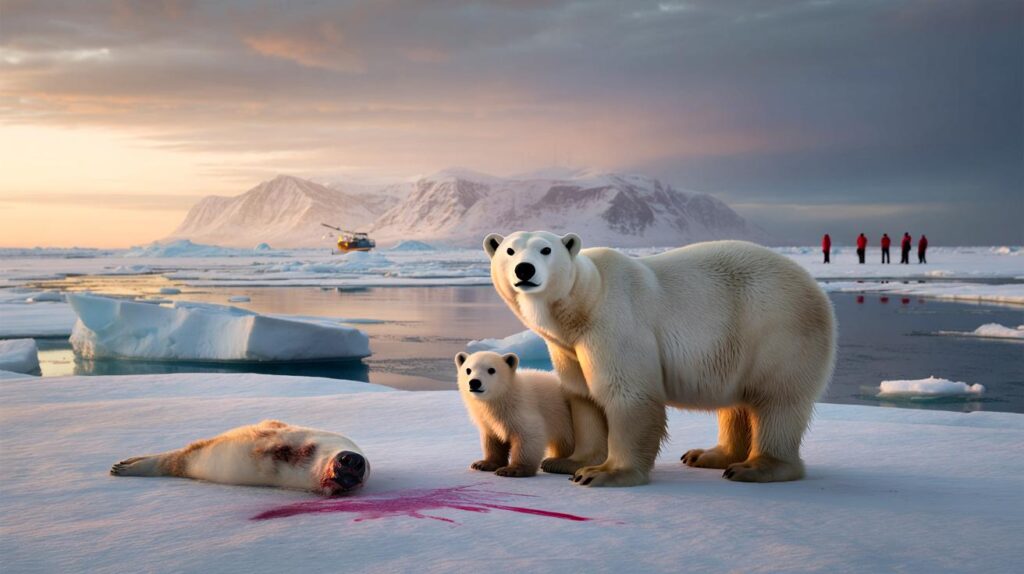
From the air, the researchers trade quick glances. They’ve been flying over Svalbard for years, tracking bears, measuring them, worrying about them. Lately, though, the numbers – and the bodies – are telling a slightly different story.
 Simple Daily Yoga Flow With 6 Poses That Increase Energy Improve Focus and Clear Mental Fog
The Arctic is heating faster than almost anywhere on Earth.
 Amazon : A 7.5-metre giant anaconda never seen before is found during a Will Smith documentary shoot
Yet here, around Norway’s far north, some of the top predators look… better fed than ever.
On the sea ice with Norway’s unexpectedly chubby polar bears
A few kilometres off the coast of Spitsbergen, the ice groans softly under boots and gear. Marine biologist Jon Aars from the Norwegian Polar Institute steps toward a tranquilized bear, his breath fogging the air. Up close, you notice everything: the thick fat under the fur, the heavy paws, the lazy rise and fall of a chest that clearly hasn’t missed many meals.
This is not the skeletal symbol that dominates climate campaigns. This is a 250‑kilogram female with good teeth, a glossy coat and fat reserves deep enough to ride out a long winter. For the team that weighs and measures her, the tape doesn’t lie.
Over more than four decades, Norwegian scientists have gathered data from thousands of polar bears in the Svalbard region. They log body length, girth, fat thickness, reproductive success, and the number of cubs clinging to a mother’s side. When they compare today’s records with those from the 1990s, one pattern keeps coming back: in key parts of the Barents Sea population, bears are heavier and in better condition.
Some females are carrying more cubs. Cubs are surviving at higher rates. It’s a quiet statistical story, hidden under layers of sea ice reports and greenhouse gas graphs, but on the spreadsheets, the trendline slopes… upward.
Scientists point to a surprising chain reaction. As sea ice near Svalbard melts and retreats earlier in the year, warm Atlantic water flows further north. That boosts productivity in the sea, feeding more fish and plankton. Seals, especially ringed and bearded seals, feast on that boom, swell in number and in size, and haul out on the remaining ice or along the coasts.
The local polar bears, still able to hunt from drifting floes and coastal ice, suddenly find themselves in a kind of Arctic buffet. More seals. Fatter seals. Longer hunting seasons close to land. The result isn’t a fairy tale of climate resilience. It’s a small, local twist in a bigger, darker story.
Why some Arctic predators are thriving while the ice melts under them
To understand what’s happening around Svalbard, you need to watch how a bear actually hunts. Picture one lying flat on the ice near a seal breathing hole, barely moving, just nostrils and ears working. When a seal surfaces, the bear explodes forward, grabs it with claws like meat hooks, and drags it onto the ice. That seal can contain tens of thousands of calories.
If the ice edge is still reachable and seals are concentrated near it, each successful ambush is a jackpot. A few good kills in spring can make or break an entire year for a bear.
In recent years, satellite images and drone footage have shown seal colonies crowding new spots near Svalbard as the ice zone shifts. Some fjords that were once locked in ice are now open longer, full of fish and plankton. Seals follow the food. Bears follow the seals.
Researchers have tracked adult females swimming shorter average distances than before, yet returning to shore heavier. On land, cameras catch them lounging on beaches spattered with seal remains, rolling on their backs in the midnight sun like overgrown labradors who found the snack cupboard.
The paradox is that the same climate forces helping some Norwegian bears are hurting polar bears elsewhere. In Western Hudson Bay in Canada, for example, spring ice breaks up earlier and forms later. Bears there must fast longer on land, and their body condition has dropped.

So what looks like good news around Svalbard is also a warning. A slight shift in currents and ice patterns turns one region into a temporary winner, another into a loser. **Climate change doesn’t move in straight, simple lines.** It creates pockets of abundance and pockets of scarcity, and wild animals are scrambling to adjust.
How researchers read fat, fear and the future on a polar bear’s body
For the scientists in Svalbard, each captured bear is like a living time capsule. They don’t just eyeball “chubby” or “thin.” They weigh the bear, measure its neck and torso, sample blood, and sometimes use ultrasound to estimate fat layers. Then they tag the animal with a satellite collar or ear transmitter before it wakes.
Over years, those GPS pings draw messy tracks across the map: loops around ice edges, sudden dives to distant floes, long coastal patrols. A fat bear whose collar shows shorter, efficient hunting trips is telling a very specific story about how this new Arctic works.
When the first signs of improved body condition appeared in Norway’s Arctic bears, some conservationists felt uneasy. Good news is welcome, yes, but confusing news can also muddy public understanding. Many people already feel fatigued by climate headlines.
There’s a risk that images of plump Svalbard bears get spun into a comforting myth: maybe they’re fine, maybe nature will just adapt. *That’s not what the data says.* Researchers keep repeating that this is a regional, likely temporary benefit, not a get-out-of-jail-free card for burning fossil fuels.
“People see a fat polar bear and want to relax,” one field biologist told me, shrugging inside his thick red parka. “But what we’re seeing is a brief window where the system still works for them. If the ice keeps retreating, that window will close.”
- Short term: More open water boosts marine productivity, feeding seals and, by extension, local bears.
- Medium term: Continued warming shifts ice even farther, forcing bears to swim longer distances and burning those hard‑won fat reserves.
- Long term: If summer sea ice disappears from the Barents Sea altogether, the core hunting platform for polar bears collapses.
Let’s be honest: nobody really checks the fine print behind those heartbreaking polar bear photos that zigzag across social media. This slow, technical story about fat percentages and seal dynamics rarely goes viral, but it’s where the real drama lives.
A rare piece of good news – and the uneasy questions behind it
Standing on a Svalbard ship’s deck at midnight, with pink light brushing the mountains and a cold wind licking your face, it’s easy to feel two things at once. Relief that some bears here are thriving. A dull ache that this might be just a brief, lucky chapter in a longer decline.
The crew on board whisper and point as a mother and two cubs pad along the ice edge below, round and healthy, their fur glowing against the sea. It feels like a small victory on a big, complicated battlefield.
We’ve all been there, that moment when a piece of unexpected good news lands in the middle of an otherwise rough week. That’s what these fat Norwegian bears are to many researchers: a reminder that nature still has tricks, still has resilience, still surprises us.
At the same time, the bigger picture hasn’t changed. Global ice loss is accelerating. Other polar bear populations are sliding the opposite way. The species remains classed as vulnerable worldwide, and the Arctic continues to heat at roughly four times the global average.
So what do we do with this contradiction? Maybe we treat it as a nudge to drop the lazy, single-image version of climate change – the lone starving bear on a tiny floe – and replace it with something messier, more honest. A world where some animals gain weight for a decade while others vanish. A world where **local wins don’t cancel global risks**.
Stories like Svalbard’s are not an excuse to slow down. They’re a reason to look closer, ask sharper questions, and accept that the future of the Arctic won’t fit neatly into a single photograph.

| Key point | Detail | Value for the reader |
|---|---|---|
| Regional gains | Some polar bears in Norway’s Arctic are fatter and healthier thanks to more productive coastal waters and abundant seals. | Shows that climate impacts can be uneven, not always uniformly negative in the short term. |
| Hidden risks | Long‑term sea‑ice loss could erase the current benefits by removing core hunting platforms. | Helps the reader avoid false comfort from isolated “good news” stories. |
| Complex signals | Improved body condition here contrasts with declines in other bear populations like Western Hudson Bay. | Encourages a more nuanced view of climate change and wildlife resilience. |
FAQ:
- Are all polar bears getting healthier in a warming Arctic?No. The positive trend in body condition mainly concerns parts of the Barents Sea population near Svalbard, while several other populations worldwide are stable or declining.
- Why are some Norwegian polar bears getting fatter?Retreating sea ice and warmer Atlantic waters have boosted marine productivity, feeding more seals, which gives local bears richer hunting grounds for now.
- Does this mean polar bears are adapting fine to climate change?Not really. The improvement appears regional and likely temporary; long‑term projections still show major risks as sea ice continues to shrink.
- Are there more polar bears in Norway now?Some indicators, like cub survival, have improved, but exact population trends are complex and vary within the Barents Sea region.
- What can ordinary people actually do about this?Reducing personal and political support for fossil fuel use, backing strong climate policies, and supporting Arctic conservation groups all feed into the bigger system shaping these bears’ future.
