
New research from the United States suggests that two key brain regions keep time together to coordinate every gesture, word and step we take, raising fresh hopes for tackling conditions such as Parkinson’s and Huntington’s disease.
The brain’s invisible clock
We can feel heat, see light and smell odours, but we have no sense organ for time. Yet we still clap in rhythm, hit a ball, or pause just long enough before replying in a conversation. That kind of precise timing has long puzzled neuroscientists.

A team at the Max Planck Florida Institute for Neuroscience (MPFI) has now shown that the brain appears to run an internal stopwatch shared between the motor cortex and the striatum, two regions already known to be central to movement.

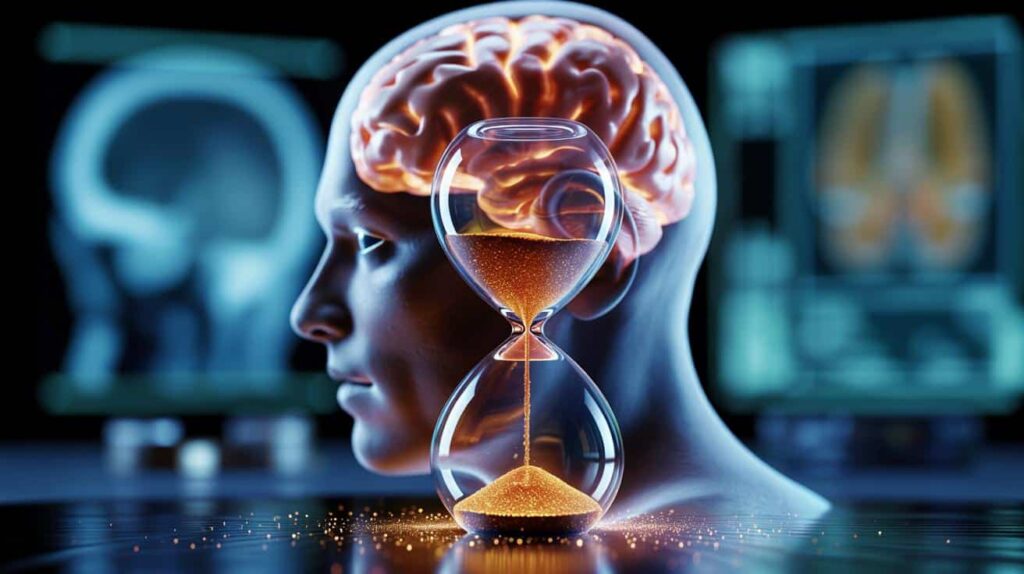
Researchers found that the motor cortex and the striatum share timing duties in a tightly coordinated way, much like the two bulbs of an hourglass.
The findings, published in the journal Nature, suggest that this “hourglass” system lets the brain flexibly speed up, slow down or restart actions with surprising precision.
Two areas, one shared timer
The motor cortex, located near the top of the brain, sends commands that shape voluntary movement. The striatum, deeper inside, helps start and fine-tune those movements, and is heavily affected in both Parkinson’s and Huntington’s disease.
Previous work had hinted that both regions contribute to timing, but their exact roles were murky. The new study tackled a basic question: how do these two structures actually work together to measure time?
The team found that the motor cortex behaves like the top of an hourglass, sending a steady stream of signals that “pile up” in the striatum until it is time to move.
Once the accumulated signal in the striatum passes a threshold, it triggers a specific movement. If the stream from the cortex changes, the timing of that threshold — and the movement — shifts with it.
Teaching mice to “wait for it”
To probe this hidden clock, the researchers trained mice to perform a simple but demanding task. The animals learned they would receive a reward if they licked a spout at a precise time after a cue, such as one second later.
That meant the mice had to “count” internally, holding back their movement until the right moment. While the mice waited and then licked, scientists recorded the activity of thousands of neurons in both the motor cortex and the striatum.
- The cue signalled when to start timing.
- The internal clock ran silently in the background.
- The mice licked only when their internal timer said the second was up.
The neural recordings showed that activity in the motor cortex ramped up in a particular pattern, while signals in the striatum gradually built up, mirroring the passage of time much like sand piling at the bottom of an hourglass.
Freezing and rewinding the brain’s stopwatch
The team then took a bolder step: they tried to interrupt the brain’s timing mechanism mid-task to see what would happen. They used optogenetics, a technique that lets scientists switch specific neurons on or off using pulses of light.
Silencing the motor cortex: time paused
When the researchers temporarily silenced neurons in the motor cortex, they effectively pinched the “neck” of the brain’s hourglass.
Stopping motor cortex activity halted the flow of timing signals to the striatum, as if the brain’s stopwatch had been frozen in place.
This interruption meant the striatum no longer received its usual buildup of signals. The mice then licked later than expected, as though, from their point of view, time had simply stopped for a moment and then resumed.
Silencing the striatum: time reset
Turning off the striatum produced a different and striking effect. Instead of just pausing the clock, it seemed to reset it.
With the striatum briefly silenced, earlier accumulated signals were effectively wiped away, comparable to flipping an hourglass over. When activity resumed, timing started again from zero.
Disrupting the striatum made the animals behave as if the clock had been rewound and they were starting to count all over again.

The mice then delayed their lick for even longer, which fits the idea of a reset rather than a simple pause. The contrast between the two manipulations suggested that each region plays a distinct and complementary role in measuring time.
Why this matters for movement disorders
The motor cortex and striatum are both strongly implicated in movement conditions that affect hundreds of thousands of people across Europe and North America.
| Disorder | Mainly affected region | Typical movement issue |
|---|---|---|
| Parkinson’s disease | Striatum and related circuits | Slowness, stiffness, tremor |
| Huntington’s disease | Striatum | Involuntary jerky movements |
| Dystonia and some tremors | Motor cortex–basal ganglia loops | Abnormal postures, repetitive movements |
Many of these conditions involve disrupted timing: steps become irregular, speech breaks up, and movements either lag behind intent or arrive uncontrollably early. A damaged hourglass cannot measure time reliably, and the same logic appears to apply to the diseased brain.
By clarifying how the motor cortex and striatum share timing duties, the study points towards new strategies for restoring smoother, more predictable movement.
In theory, future therapies could try to nudge this internal timing system back into a healthier rhythm. That might mean tailored brain stimulation, targeted drugs, or even training programmes that reshape how these circuits fire.
From lab mice to everyday life
The task in the study was simple, but the principles extend far beyond a mouse licking for a treat. Human activities often depend on finely tuned internal timing, even when we do not realise it.
Consider a few everyday examples:
- Speaking fluently requires precise pauses between words and syllables.
- Catching a ball demands an accurate prediction of when it will arrive.
- Typing quickly needs tightly timed finger movements in sequence.
- Playing music depends on keeping a beat while planning the next note.
In each case, the brain must predict and control when a movement should unfold, not just what that movement should be. The hourglass model gives researchers a concrete way to think about those predictions at the cellular level.
Key terms behind the science
A couple of technical concepts sit at the heart of this research. Understanding them helps make sense of the hourglass idea.
Motor cortex: a region of the brain’s outer layer that sends commands to muscles. It helps plan, start and shape voluntary movement, from finger taps to facial expressions.
Striatum: a cluster of structures buried deeper inside the brain, forming part of a network known as the basal ganglia. It weighs up signals from several cortical areas and feeds back to influence movement, habit formation and decision making.
Optogenetics: a method where neurons are genetically modified to respond to light. Shining light lets researchers briefly switch those cells on or off with high precision, something that is not possible with medication alone.
What this could mean in the coming years
While the findings are early and based on animal studies, they sketch out realistic scenarios for future research and treatment. One possibility is smarter deep brain stimulation for Parkinson’s disease that does not just reduce tremor but also recalibrates timing signals in the striatum.
Another scenario involves digital training tools. If clinicians can identify people whose internal hourglass runs too fast or too slow, they may design exercises that gradually re-shape how the motor cortex and striatum interact. Simple tasks on a screen, such as tapping with precise delays, could one day be tuned to push these circuits towards healthier timing.
There are also risks to consider. Intervening directly in timing circuits might alter more than movement. The striatum also plays roles in motivation and reward, so poorly targeted therapies could affect mood or decision making. Careful testing will be needed before any clinical use.
For now, the study gives a sharper view of something that affects an entire country’s population, whether through ageing, motor disease or everyday slips and stumbles. Movement depends not just on strength and coordination, but on an internal flow of time — and two small regions of the brain seem to keep that flow running, grain by grain, like an hourglass.
 Simple Daily Yoga Flow With 6 Poses That Increase Energy Improve Focus and Clear Mental Fog
