The burial, unearthed in 2017 at a Byzantine monastery, raised immediate questions. Only years later did researchers realise the chained skeleton was not a male holy man, but a woman whose life – and death – point to harsh religious practices in the early Christian centuries.
An eerie tomb near Jerusalem
The grave was uncovered at Khirbat el-Masani, a Byzantine monastic site to the north-west of Jerusalem’s Old City. The complex, occupied around the 6th–7th centuries CE, included several rock-cut crypts used by monks and religious devotees.

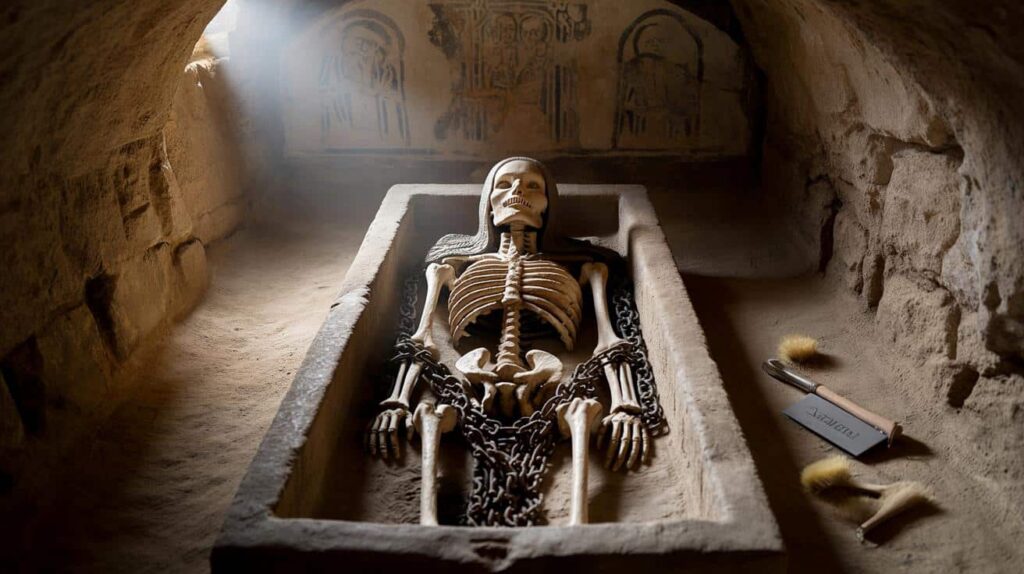
Inside one of these crypts, archaeologists from the Israel Antiquities Authority found a single coffin. When they opened it, they encountered a skeleton literally draped in iron chains, some of them thick enough to restrain an animal.

This was not a prisoner’s shackles dumped into a grave; the chains were part of the deceased’s religious identity and buried carefully with the body.
Early interpretations pointed towards a male Christian ascetic — one of the so-called “chain-bearers” known from Byzantine religious texts. These men deliberately wore chains for years as a form of extreme self-denial, believing physical suffering brought them closer to God.
Given that written sources mainly mention male ascetics, the assumption seemed safe at the time: the chained skeleton, everyone thought, had to be a man.
A quiet scientific twist: the “man” was a woman
Eight years after the excavation, a team of specialists returned to the bones with new technology. Their results, published in the journal Science Direct, dramatically overturned that first reading.
The skeleton was in poor condition. Many of the bones had decayed, making traditional visual methods of determining sex unreliable. Instead, researchers analysed tiny protein fragments, called peptides, preserved in the tooth enamel.
By reading microscopic proteins in the teeth, scientists concluded the chained ascetic from Khirbat el-Masani was biologically female.
The peptide method has become a powerful tool in archaeology, especially when DNA is too degraded or when skeletal features are ambiguous. In this case, it showed clearly that the person in the coffin had been a woman aged somewhere between 30 and 60 at the time of death.
That single finding transforms the whole story of the tomb. The burial is now one of the rare physical traces of a female Christian ascetic who used iron chains as part of her religious practice.
Female ascetics in a harsh spiritual landscape
Byzantine religious texts do mention women who chose extreme piety: widows who refused remarriage, noblewomen who donated their wealth and retired to monasteries, and hermits who withdrew from cities to live in near-total isolation.
Yet historical sources suggest female asceticism was usually framed differently from male extremes. Women often lived in communities, with some protection and structure, rather than on pillars or in caves. Their renunciations tended to focus on sexual abstinence, fasting, and humble work.
The chained woman at Khirbat el-Masani pushes against that pattern, showing at least one woman adopted a bodily discipline as severe as her male counterparts.
Scholars suspect she may have been part of the social elite. Many known female ascetics of the 4th and 5th centuries came from wealthy or noble families. Renouncing comfort made a powerful spiritual statement, especially for someone used to privilege.
Chains as a spiritual tool, not a prison device
To modern eyes, the use of chains looks like punishment. For Byzantine ascetics, chains were something quite different: a chosen burden, not an imposed sentence.
- They symbolised ongoing penance and humility.
- They physically restricted movement and comfort, reinforcing self-control.
- They served as a visible sign of radical devotion in the community.
Texts from the period describe “chain-wearers” who slept sitting up, endured the weight of iron on their skin for years, and saw pain as a path to holiness. In that context, the woman from Khirbat el-Masani likely accepted the chains willingly, perhaps as part of a vow.
 The baking tray in the oven will shine like new: a clever trick without expensive chemicals
Archaeologists point out that the chains were carefully arranged in the coffin, not crudely wrapped around the body like restraints. That suggests those who buried her respected her status and preserved her chosen discipline even in death.
Were these religious practices also punishments?
The line between voluntary penance and social pressure was thin in some early Christian communities. What looks like a personal vow could also operate as a form of religious control.
In a world where spiritual authority often rested with male leaders, a woman adopting extreme practices might have been celebrated, but also closely monitored. Chains turned the body into a visible site of discipline, and that discipline could be encouraged, praised, or quietly demanded by the community.
The chained burial hints at a religious culture where suffering was normalised and, at times, blurred into a kind of sacred punishment.
This does not mean the woman was a criminal. There is no sign she was executed or shackled by force. Instead, her life appears to have been shaped by a belief system where physical hardship, submission, and restraint were seen as paths to spiritual power.
What the grave tells us about daily life
Although the coffin did not yield rich jewellery or elaborate decoration, several details help reconstruct her reality:
| Element | What it suggests |
|---|---|
| Monastery burial | She was associated with a religious community, likely respected within it. |
| Careful placement of chains | The chains were meaningful, not an embarrassment to be hidden. |
| Age at death (30–60) | She survived long enough for extended ascetic practice, not a brief teenage experiment. |
| Lack of rich grave goods | A lifestyle of renunciation, consistent with vows of poverty or humility. |
How peptide analysis reshapes old digs
The sex reassignment of this skeleton, from male to female, highlights how new methods can overturn decades of assumptions in archaeology.
Many ancient skeletons, especially fragmentary ones, were catalogued as “male” or “female” based on skull shape, pelvis, or even associated objects like weapons or jewellery. These clues can be misleading, especially when cultural expectations creep into interpretation.
Tooth-peptide analysis offers a way to check those old labels, revealing where bias or poor preservation led researchers astray.
In practice, this means that other supposed “male ascetics” buried with chains or unusual markers might actually include more women than previously thought. Future studies at monasteries across the eastern Mediterranean could quietly rewrite the gender map of early Christian austerity.
From ancient chains to modern debates
The story of the chained woman near Jerusalem touches on questions that still resonate today: how far can religious devotion go, and where does voluntary sacrifice turn into harm?
Modern religious communities rarely use literal chains, yet forms of severe fasting, isolation, or self-denial still exist. Psychologists studying extreme devotion point out that some people experience genuine meaning and empowerment in acts of sacrifice, while others suffer lasting trauma.
Looking at this Byzantine grave as a real-life case study can sharpen those discussions. Imagine, for instance, a contemporary believer choosing to live in permanent physical restraint as a vow. The ethical, medical, and legal dilemmas would be intense: bodily autonomy on one side, safeguarding against self-harm on the other.
For historians and theologians, the Khirbat el-Masani skeleton becomes a concrete reference point when explaining terms like “asceticism” or “penitential practice” to students and the public. Rather than just describing abstract concepts, they can talk about one specific woman whose bones still carry the imprint of her chosen discipline.
For visitors wandering through Jerusalem’s churches and archaeological sites, the story adds another layer. Beneath the mosaics and chapels, there were individuals whose spiritual hunger led them to embrace chains, pain, and radical limitation of the body — and at least one of them, we now know, was a woman.