While most of us see snow as a nuisance that blocks roads and buries solar panels, a research team in California now sees it as a vast, untapped energy resource. Their idea is bold: turn every snowflake into a tiny generator, and use this power to create clean hydrogen fuel for thousands of years.
Snowflakes as tiny power plants
The project, developed at the University of California, Los Angeles (UCLA), carries a name that sounds like science fiction: Snow‑TENG, short for “snow‑based triboelectric nanogenerator”. The principle behind it is surprisingly simple.

Snow naturally carries a positive electric charge. When it hits a material with a negative charge, electrons move between the two surfaces. That transfer of electrons can be harnessed as electricity.

Instead of treating snow as the enemy of solar power, the researchers are trying to turn it into a partner.
After testing many materials, the team led by Professor Richard Kaner and researcher Maher El‑Kady settled on silicone. It is cheap, easy to manufacture, widely available and, crucially, has the right electrical properties to pull electrons from the charged snow.
How the Snow‑TENG device actually works
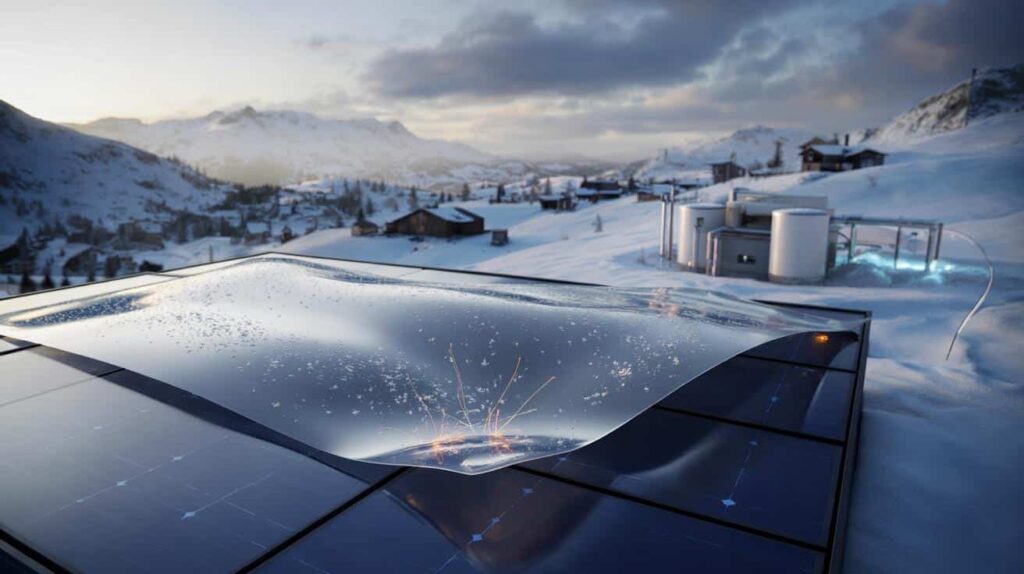
The Snow‑TENG is designed as a thin, flexible, transparent sheet that can be placed over existing solar panels or other surfaces exposed to snowfall.
- When the sky is clear, the sheet lets sunlight reach the solar cells underneath.
- When it snows, flakes land on the silicone surface.
- The collision between snow and silicone triggers a triboelectric effect, generating an electric charge.
- This charge is collected and converted into usable electrical power.
This approach tackles two common winter problems at once: solar panels usually lose efficiency under heavy snow, and energy demand rises as people turn up heating. A Snow‑TENG layer could help recover some of that lost energy during snowy days, when traditional solar output drops.
The same device that lets in sunlight under blue skies can turn snowstorms into a source of power.
A quiet, low‑cost alternative to wind and dams
One standout feature of Snow‑TENG is how little disturbance it adds to the landscape. Unlike wind turbines or hydroelectric dams, it has no moving blades, no massive concrete structures and no rotating machinery.
The generator is:
- Passive: it works as snow naturally falls, with no need for tracking or rotation.
- Silent: no mechanical noise, which makes it suitable for urban rooftops or remote cabins.
- 3D‑printable: components can be produced with low‑cost printers, opening the door to local fabrication.
- Scalable: sheets can be small enough for a backpack or large enough to cover solar farms.
Cost is a major factor. Silicone sheets are relatively inexpensive, and the additional electronics required are modest compared with building a new turbine or dam. That makes it attractive for mountainous regions or northern communities where big infrastructure projects face tough political and environmental resistance.
From snow to hydrogen: a closed, clean loop
Where the UCLA team goes further is in what they want to do with the electricity. Rather than only powering lights or charging batteries, they are looking at using the snow‑generated electricity to produce hydrogen through electrolysis.
Snow becomes both the source of electricity and the raw material for future fuel.
Here is the cycle the researchers are aiming for:
| Step | What happens |
|---|---|
| 1. Snowfall | Snow accumulates on Snow‑TENG surfaces, creating electric charge. |
| 2. Power generation | The triboelectric effect turns this charge into usable electricity. |
| 3. Melting | Collected snow melts into water in storage tanks. |
| 4. Electrolysis | Electricity splits water molecules into hydrogen and oxygen. |
| 5. Storage | Hydrogen is stored as a clean fuel for later use. |
Hydrogen is often presented as a promising energy carrier for heavy industry, trucks, ships and backup power. The challenge has always been that producing hydrogen usually requires large amounts of electricity, which may come from fossil fuels. Snow‑powered electrolysis could cut that link.
By using locally generated renewable electricity, the hydrogen produced from melted snow would carry a far smaller carbon footprint. That is where the claim of “energy for millennia” comes in: as long as snowfall patterns remain, the process could, on paper, repeat year after year without depleting a finite resource.

Where this technology could matter most
Snow‑based generators will not change life in tropical regions. They are clearly aimed at cold climates, high altitudes and places with harsh winters. Yet those are precisely the regions where winter energy shortages can be most acute.
Potential applications include:
- Mountain villages that currently depend on diesel for winter electricity.
- Ski resorts seeking to cut emissions while guaranteeing reliable power during peak tourist season.
- Remote research stations in polar or alpine regions, where diesel fuel is expensive to transport.
- Grid‑connected cities that already use rooftop solar but lose output under heavy snow cover.
In these settings, Snow‑TENG layers could sit on existing solar arrays, rooftops, weather stations or even on tents and temporary shelters.
For communities accustomed to treating snowfall as a logistical headache, it could turn into a strategic asset.
Open questions and realistic expectations
The technology is still experimental. Researchers need to show it can operate for years without losing performance, cracking in the cold or becoming clogged with ice. Real‑world snow is not always clean, and dust, soot or pollution could affect efficiency.
Another point is scale. Current lab devices produce modest amounts of electricity, enough for sensors, small lights or experimental electrolysis setups. Scaling Snow‑TENG up to industrial hydrogen production would require vast surfaces and careful integration with storage systems.
There are also climate considerations. Some regions may see reduced snowfall as global temperatures rise, while others might experience more intense winter storms. Energy planners would have to treat snow power as one part of a broader mix that includes wind, sun, hydro and storage.
What triboelectric generation actually means
The word “triboelectric” refers to electricity produced by friction or contact between materials. A familiar example is rubbing a balloon on your hair and making it stick to a wall. That sticking is the triboelectric effect in action.
In Snow‑TENG, the snowflake is the balloon and the silicone sheet is the jumper. Each tiny impact transfers charge. While each event is small, the combined effect across a large surface during a snowfall can be significant.
Engineers are already testing triboelectric generators in shoes, road surfaces and clothing, where everyday motion powers sensors. Snow‑based devices are part of that broader push to scavenge energy from ordinary physical contact.
What a snow‑powered future might look like
Picture a mountain town a few decades from now. Roofs are lined with transparent sheets that quietly generate electricity each time a storm hits. Melted snow runs into underground tanks, where small electrolysers convert it into hydrogen. That hydrogen then powers local buses, backup generators and maybe even small industry.
In another scenario, ski lifts, avalanche sensors and remote weather stations operate almost entirely from snow‑derived electricity, reducing the need for diesel tanks dotted across fragile alpine environments. For emergency responders, temporary Snow‑TENG mats could provide electricity and hydrogen in disaster zones struck during winter.
Not every region will embrace this approach. But as researchers refine the materials, test durability and calculate true costs, snow could shift from seasonal burden to part of a long‑term energy strategy, particularly in countries facing both cold winters and ambitious climate targets.