They slipped beneath choppy water near North Sulawesi, chasing rumours whispered in dockside cafés. Minutes later, their torches picked up something that seemed to have swum straight out of prehistory.
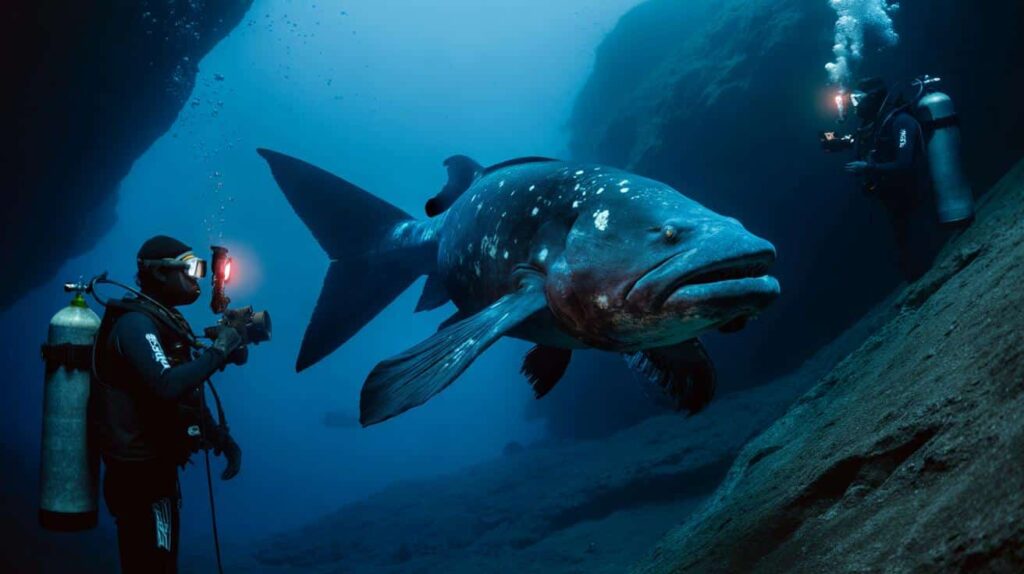
A blue silhouette at the edge of the light
At around 40–50 metres, the reef wall fell away into blackness. The clatter of the boat had faded. Only bubbles and dive computers broke the silence. Then one torch beam froze on a shape hanging motionless in the gloom.
It was big, almost the length of a person. Thick, lobed fins rotated like slow paddles. The body was armoured in chunky scales that threw back the light. White spots traced patterns along its flanks, like a constellation painted on blue stone.
The divers knew that outline from scientific drawings and grainy archive photos. They were staring at a coelacanth, a species thought wiped out with the dinosaurs and later branded a “living fossil” when it turned up alive in the 1930s.
French technical divers have filmed one of Indonesia’s elusive coelacanths in its natural habitat, producing the first images of their kind by a French team in these waters.
The fish didn’t dart away. It simply turned, heavy and deliberate, as if mildly irritated, then drifted a little deeper, still within the reach of their lights and cameras. For several long minutes, deep history and modern technology shared the same narrow slice of water.
Months of planning for a few surreal minutes
This meeting was no casual holiday dive. The French group had spent months preparing for a narrow window of opportunity in North Sulawesi, one of the few regions where Indonesian coelacanths have been recorded.
Turning rumours into a dive plan
They started with fragments of information: stories from fishers about “strange blue fish” from deep nets, blurry smartphone photos, and scattered scientific reports dating back to the late 1990s. Coelacanths here tend to haunt steep underwater cliffs and caves, often between 150 and 300 metres.
That depth is beyond normal recreational limits, so the team had to look for places where cold currents or hunting patterns might bring the animals a little shallower. They layered different sources of data:
- Bathymetric charts showing drop-offs and undersea canyons
- Ocean temperature and current models for the region
- Interviews with local fishers and guides
- Previous academic surveys and catch records
- Test dives to check visibility, current strength and access
The result was a shortlist of likely ledges and caves starting around 50–60 metres, on walls that plunged into much deeper water. The plan was simple on paper: get there quietly at the right time of day, stay safe, and wait.
Technical diving on the edge of comfort
The dives themselves were demanding. The team flirted with depths close to 60 metres, using technical gas mixes, strict time limits and careful ascent profiles.
They chose dawn and dusk, when many deep animals rise a little higher in the water column. Lights were kept dim to avoid scaring anything large that might be resting in cracks along the rock face. No scooters, no big groups, no chasing shapes into the dark.
On the night that finally delivered, conditions were far from ideal. The sea was rough, visibility poor, current strong enough to drag them along the wall. One diver signalled to turn back. Another spotted a cave and suggested a quick look. The coelacanth slid out from underneath them, as if it had always been there.
The encounter felt improbable, but the odds had been nudged for months by methodical preparation, local cooperation and a willingness to accept dozens of “empty” dives.
A fish that rewrites our sense of time
The coelacanth line dates back roughly 400 million years, long before dinosaurs, long before flowering plants on land. The modern species has changed over time, but its overall body plan still echoes those ancient ancestors.
When the first living coelacanth was hauled up off South Africa in 1938, scientists were stunned. Until then, the animal was known only from fossils. Its sudden reappearance became a symbol of how much remains hidden in the deep ocean.
Indonesia’s coelacanths, identified as a separate species in the late 1990s, remain even more mysterious. Most records involve accidental catches or submersible footage from very deep water. Footage taken directly by divers in situ is rare worldwide, and in Indonesian waters almost unheard of.
| Aspect | Detail | Why it matters |
|---|---|---|
| Age of lineage | ~400 million years | Shows how long some lineages can persist with relatively stable body plans |
| Usual depth range | 150–300+ metres | Places them beyond reach of most divers and many fishing gears |
| Indonesian records | Late 1990s onwards | Highlights how recently science recognised these populations |
| Current threats | Deep fishing, habitat disturbance, climate shifts | Raises questions about resilience after surviving past mass extinctions |
Scientists caution against taking the phrase “living fossil” too literally. Coelacanths have evolved and adapted over millions of years. Still, meeting one face to face forces divers and viewers alike to stretch their sense of time far beyond human history.
Respecting limits: no thrill-seeker’s checklist
News of such a sighting can tempt ambitious divers to plan their own deep hunts for coelacanths. The French team’s experience sends a very different message.
A code built on restraint, not adrenaline
From the outset, the expedition adopted a low-impact approach:
- Small teams to reduce noise and confusion at depth
- Short encounters with minimal lights on animals
- No repeated descents on the same cave or ledge
- Regular debriefs asking whether they had stressed the fish or themselves
- Shared data with Indonesian researchers instead of keeping locations secret for future photo ops
They cancelled dives when fatigue set in, even when conditions looked promising. They turned down the chance to “go back tomorrow for better footage” immediately after a sighting, prioritising safety stops and rest.
For the team, no single image was worth cutting safety margins or turning a rare encounter into a circus for social media.
Technical dives at these depths in remote parts of Indonesia carry real risk: decompression sickness, equipment failure, strong currents, limited access to recompression facilities. The coelacanth became a powerful reminder that some wildlife experiences should remain rare and carefully managed, not packaged into mass-market adventure products.
What this encounter tells us about future oceans
Images from the French dive will circulate through newsfeeds for a few days, framed as a brush with a “prehistoric monster” or a “missing link”. Behind the headlines sits a quieter story about resilience and pressure.
Coelacanths have survived multiple mass extinctions, dramatic shifts in climate and sea level, and the rearrangement of continents. They managed this by retreating to relatively stable, deep habitats. Those refuges are no longer insulated from human impact.
Deep-sea fishing, oil and gas activity, seabed mining projects and warming currents all reach into the zones coelacanths use. Even a slight increase in temperature can alter oxygen levels and prey distribution along steep slopes where these fish rest by day and hunt by night.
New footage, including this French material, can help researchers refine models of habitat use and behaviour. Details such as body posture, distance from the rock face, reaction to light and current, and the structure of surrounding caves all feed into conservation planning.
Coelacanths, risk, and what non-divers can learn
You don’t need a technical diving qualification to engage with this story in a useful way. A few key ideas carry over into everyday choices and debates about the ocean.
Understanding a few core terms
Several concepts around the coelacanth often get thrown around without explanation:
- Twilight zone: The band of ocean roughly between 200 and 1,000 metres, where light fades but life remains abundant. Coelacanths live near the upper fringe of this zone.
- No-decompression limit: The maximum time a diver can spend at a given depth without needing long decompression stops on the way up. Pushing beyond this requires complex ascent schedules and raises risk.
- Bycatch: Species caught unintentionally in nets or on lines aimed at other fish. Many coelacanth records in Indonesia come from deep nets targeting different species.
When you hear debates about deep-sea trawling, offshore drilling or mining, animals like the coelacanth are part of what is at stake, even if they are never named in the policy document.
Imagining different futures
One possible future sees coelacanths fading away quietly as deeper waters warm, oxygen dips and industrial activity pushes ever further down the slopes. Sightings like the French team’s become historical curiosities, evidence of what used to lurk in submarine caves.
Another future keeps these fish where they have always been: unseen by most people, occasionally filmed by specialists, thriving in legally protected deep refuges off countries such as Indonesia, South Africa and the Comoros. In that scenario, rare images are not trophies from the last generation, but brief peeks at a neighbour we have finally learned to leave alone.
The difference between those futures turns less on a single spectacular dive and more on thousands of mundane choices: where fishing is allowed, how energy projects are licensed, whether deep habitats are factored into marine protected areas, and how often scientists and coastal communities are heard in those decisions.
Frequently asked questions
What exactly is a coelacanth, and why do people call it a “living fossil”?
A coelacanth is a large, nocturnal fish with lobed fins that share similarities with the early limb-like structures of vertebrates that eventually moved onto land. People use the term “living fossil” because its overall shape resembles fossils hundreds of millions of years old. Biologists stress that this doesn’t mean it stopped evolving; it simply changed more slowly in visible ways than many other groups.
Where in Indonesia was this individual filmed?
The French team worked off North Sulawesi, a region already known to scientists for deep slopes and canyons suitable for coelacanths. Exact cave locations are being kept vague to protect the animals and avoid a rush of high-risk copycat dives.
Can recreational divers hope to see a coelacanth on a normal trip?
Realistically, no. Coelacanths usually stay far deeper than recreational dive limits and prefer remote, steep walls. Even highly trained technical divers who target likely sites will often finish dozens of dives without a single sighting.
Does photographing such a rare species risk disturbing it?
Any approach carries some disturbance. That is why the French team limited time, used low-intensity lighting and avoided repeated visits to the same caves. Researchers reviewing the footage did not see signs of frantic escape behaviour, but long-term impacts are still poorly understood. Caution remains the default.
How could these new images help scientists protect coelacanth populations?
The footage provides context that static specimens cannot: posture, swimming style, use of caves, reactions to current and light. Combined with GPS coordinates, depth and environmental data, it supports better modelling of where coelacanths might live and how to design deep protected zones that actually overlap with their preferred refuges.